Threads of Time: Exploring Weaving Histories in Persian Carpets and Muslim Art
Persian carpet from the 20th Century- Source- Wikipedia1
Culture remains central to human civilization . Culture is deeply embedded within artistic expression, culinary practices, political systems, artefacts, and community practices, all of which constitute the lived experiences that shape human life. These experiences inform cultural norms and behaviours, and the diversity of individual and collective experiences continually contributes to the formation and transformation of cultural frameworks.
Under textile and art, aspects of this culture, carpets occupy a special place. Carpets are not just functional floor coverings in textile arts, they are recognized as significant works of artistic expression with cultural, symbolic, and aesthetic importance. It is fascinating that carpets, earlier thought of as everyday objects, became important artefacts of Islamic culture and cultural cross-exchange, across the different historical periods and dynasties2.
I first noticed the beauty of Persian carpets, spread out floor to floor in the prayer hall, where the Iranian community gathers for Majlis3, in my home city Bombay, India. These carpets had large borders with floral motifs, symmetrical geometric patterns in the middle and a big medallion in the centre, placed aptly so the chandelier from the ceiling is parallel to it. A lush red and blue, the carpet was so soft and perhaps at least 50 years old.
Later, as we were discussing family histories, I learned that my mother-in-law’s mother used to be a carpet weaver. I was fascinated to dig deeper to understand this art form I had in my home, that held so much history that I took for granted. For centuries Persian carpets have been woven by hand in small villages by nomadic tribes, in towns and by royal artisans alike in Iran. Carpet weaving in Iran has been traced back to antiquity. Greek historians have written about Persian carpets from as early as 400 BCE4. The Persian carpets from Iran went through their own artistic evolution and cultural journey – the impact of the dynasties that existed at the time, along with trade exchange, showed up in their designs. Eventually, the design of the preislamic persian carpets met with the Islamic symbolism and compositions to create a unique identity of their own, one that has stood the test of time.
From the Ilkanid period (1256-1335) to Timurid Period (13-70-1507) and Safavid period (1501-1736) the Persian carpet’s motifs took inspiration from Chinese art, incorporating motifs like the clouds and lotus and other floral patterns, moving to incorporate Islamic geometric principles, transforming carpets into harmonised designs of unity. Repeating shapes like the octagon or hexagon symbolised interconnectedness of all things in the universe, a unity of life and thought5.
The flora, fauna and the shapes and motifs, carried significant meanings and references to Persian culture and Islamic culture. For example the flower and lotus motifs symbolised purity, pomegranates symbolised fertility and life. The tree of life, a symbol of eternity, of the divine power, the cypress tree of survival, hope, renewal6. During the Timurid Period, design motifs became more layered with nature inspired motifs, representing paradise in Islamic philosophy, geometric arrangements, reflecting the structured order of the cosmos,and arabesque patterns to reinforce the concept of infinity through repetition.
The Safavid Dynasty, one of Iran’s most significant ruling dynasties, was considered the golden age of Persian carpet making. It represented the culmination of the earlier artistic influences – the medallion centric carpets, interlacing vine motifs with motifs about life taking centre stage. The curvilinear lines required artisans to set up a more elaborate weaving process. Carpets during these times were made of silk, wool and cotton7.
The Schwarzenberg Paradise Park Carpet from the Doha Islamic Art Museum8. Source https://nazmiyalantiquerugs.com/blog/indo-persian-chahar-bagh-gardens-and-rugs/
The widespread adoption of the asymmetrical persian knot also came to be the technical innovation of the time. Each province in Iran gave their carpets a distinct style. Some of these carpets took months and years to make, depending on the style, the art work, the colours and material used. The richness and purity of colours, the labour intensive technique, the balance in design and intricacy of the delicate scrolls made them the most desired by people from all over the world.
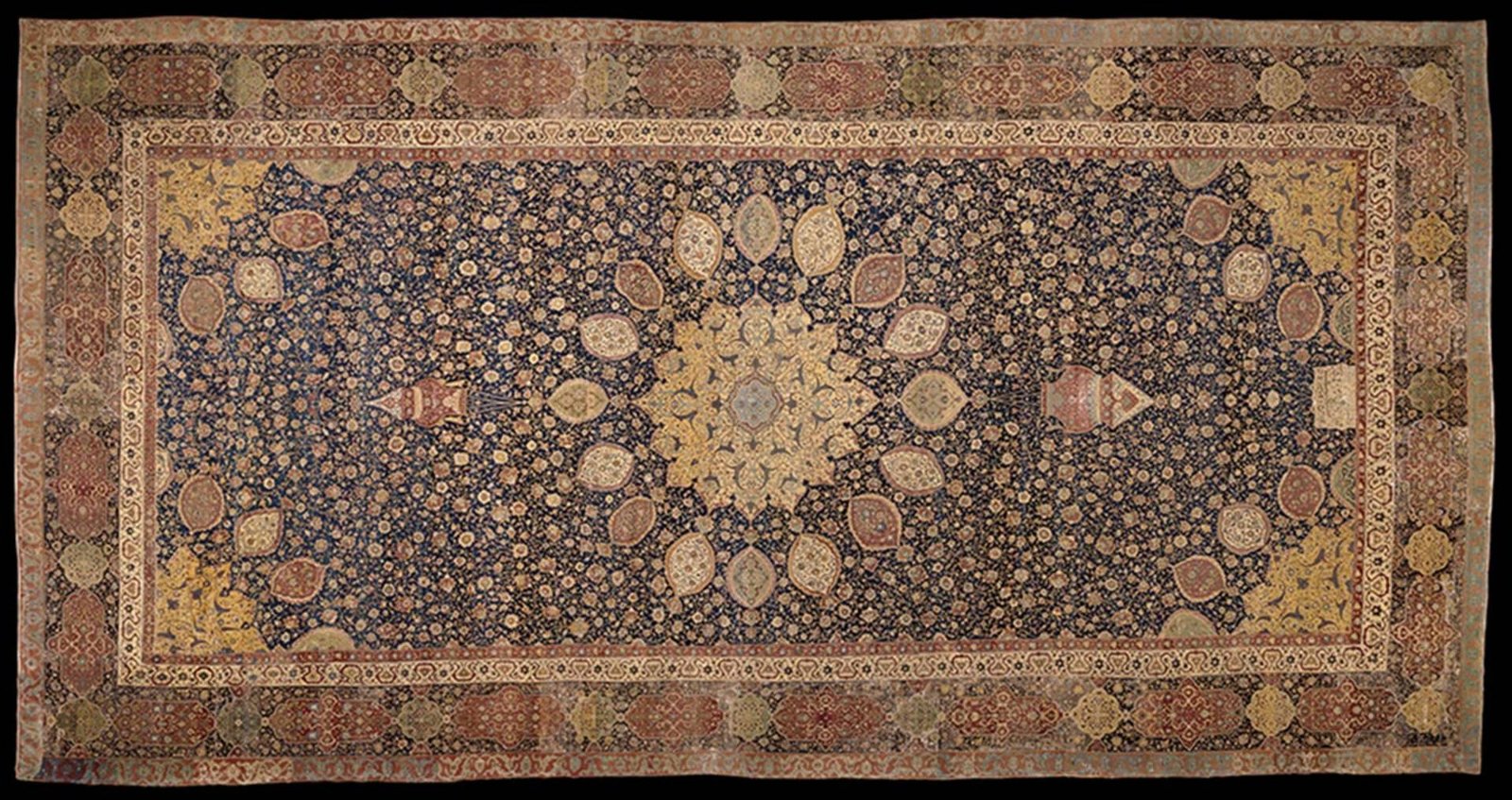
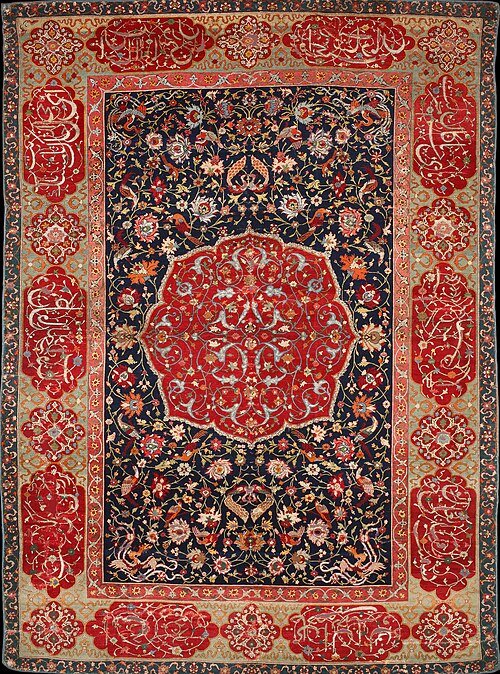
The Ardabil Carpet9 Source: https://www.vam.ac.uk/articles/the-ardabil-carpet?srsltid=AfmBOopvzBVFpO-nm1ObjEVSfmuDgSKyV0ThBd-JkxophzlJwp_-Apl_
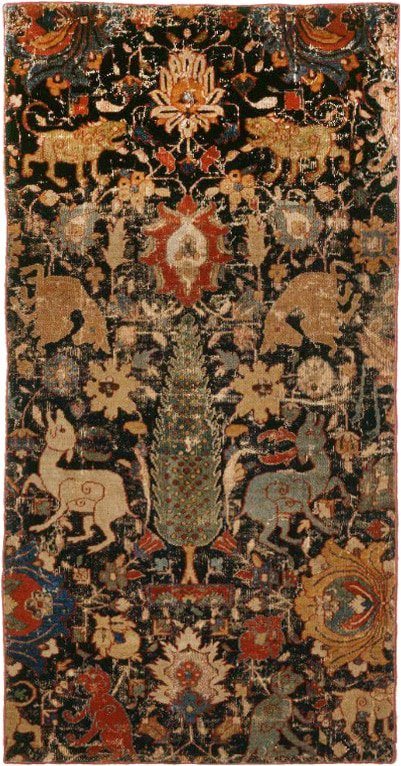
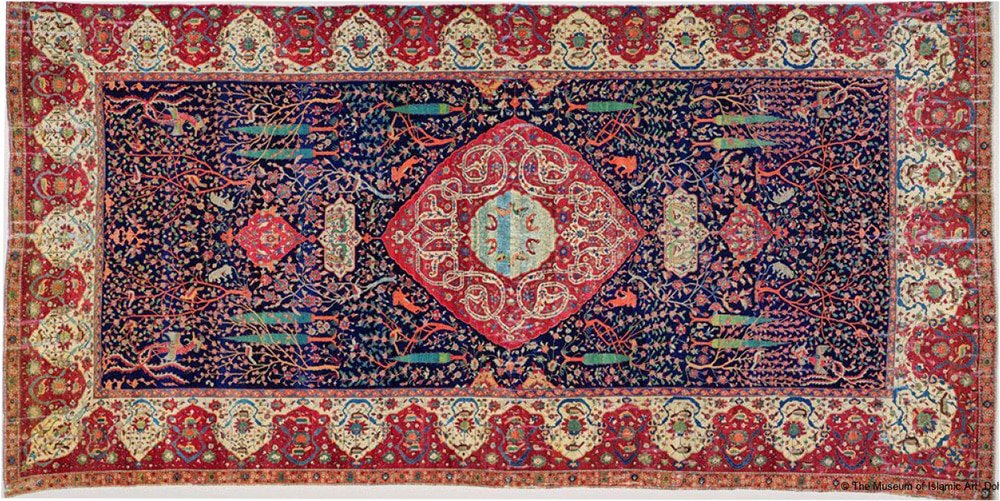
Chahar Bagh Paradise Park Design Safavid Fragment from the Montreal Museum Of Art10. Source: https://nazmiyalantiquerugs.com/blog/indo-persian-chahar-bagh-gardens-and-rugs/
Several of the most famous Persian carpets from these periods, such as the Ardabil carpet and others from the Safavid period, are housed at the Victoria and Albert Museum in London. The Pazyryk carpet11, a Persian-Armenian carpet, also known as the oldest handwoven pile carpet in the world, is housed at the Hermitage Museum in Russia. Some more of these exquisite carpets are at the Louvre in Paris, the MET Museum and the Museum of Islamic Art in Doha.
The islamic motifs and symbols have become a part of contemporary carpet making. The scale and dimensions of the designs were adjusted to match contemporary tastes. The designs were dense and complex and were often simplified for modern homes and minimalist decor. Contemporary carpet production in Iran involved the revival of traditional tribal patterns and dyeing techniques using natural dyes. This also created a continued source of income for local artisans. On the other hand, traditional carpet making also saw competition from machine-made, tufted carpets, that had simpler designs and were cheaper as they didn’t require the same artistic labour as handwoven carpets using traditional Islamic inspired motifs and styles. What people got was an ‘oriental’ looking carpet12.
It is interesting how so many of these floral arabesque motifs and geometric shapes we see within these carpets, are also seen in Islamic art and architecture all around us. from paintings, mosques or palaces, these motifs and designs have travelled to everyday home items like cutlery, bedspreads, etc without us giving much thought to their origin stories. Perhaps the next time you spot a carpet, there will be more to it than just its use.
Footnotes:
- The arabesques style is prominent in this carpet from the 16th century. One also sees the Islamic calligraphy in this carpet.
- Abouali & Kaner, 2025, Cultural Identity: How Persian Rugs Reflect Iran’s Cultural, Spiritual and Artistic Ethos in The International Journal of Environment Sciences
- A Majlis is an Arabic term for ‘sitting room’. It is used to describe religious and cultural gatherings in islamic communities.
- Keshavarz & Noshadi, 2025, The Handbook of Persian Carpets: Cultural and Semiotic Perspectives
- Abouali & Kaner, 2025, Cultural Identity: How Persian Rugs Reflect Iran’s Cultural, Spiritual and Artistic Ethos in The International Journal of Environment Sciences
- Aziz, 2004, The Meaning of Islamic Art: Explorations in Religious Symbolism and Social Relevance.
- Weisbin, Kendra. “The court carpets of the Ottoman, Safavid, and Mughal empires, an introduction” Smarthistory.
- The Schwarzenberg Paradise Park Carpet from the Doha Islamic Art Museum. In this carpet, the cypress tree, thought of as the centre of the universe, the surrounding motifs signified life in harmony. This carpet is inspired by the chahar-bagh or four garden concepts, which is usually divided by a broad longitudinal watercourse that would meet in the centre.
- The Ardabil Carpet, one of the most significant carpets in the world, was made in the town of Ardabil in north-west Iran, the burial place of Shaykh Safi al-Din Ardabili, who died in 1334. The Shaykh was a Sufi leader, ancestor of Shah Ismail, founder of the Safavid dynasty (1501-1722).
- Chahar Bagh Paradise Park Design Safavid Fragment from the Montreal Museum Of Art. Different animals, flower motifs and the cypress tree all visible in this fragment.
- https://simple.wikipedia.org/wiki/Pazyryk_rug
- https://en.wikipedia.org/wiki/Persian_carpet
(The views expressed in this article are the author’s own. Content can be used with due credit to the author and to ‘Zariya: Women’s Alliance for Dignity and Equality’)
About the Author

Zahra Gabuji is an education and developmental consultant with 14 years’ experience across arts-in-education, library programmes, gender, sexuality, disability, and digital technologies. She is building her practice through the Young Futures Project to equip young people with skills and knowledge. Zahra believes young people bring positive change when given the right information and support. She has led library and life skills programmes in schools in Mumbai, creating windows to the world for learners. Her non-profit work includes facilitating capacity building workshops, building toolkits and archives, on digital storytelling, gender, disability and digital spaces.