Muqarnas: The Art of Transition in Islamic Architecture
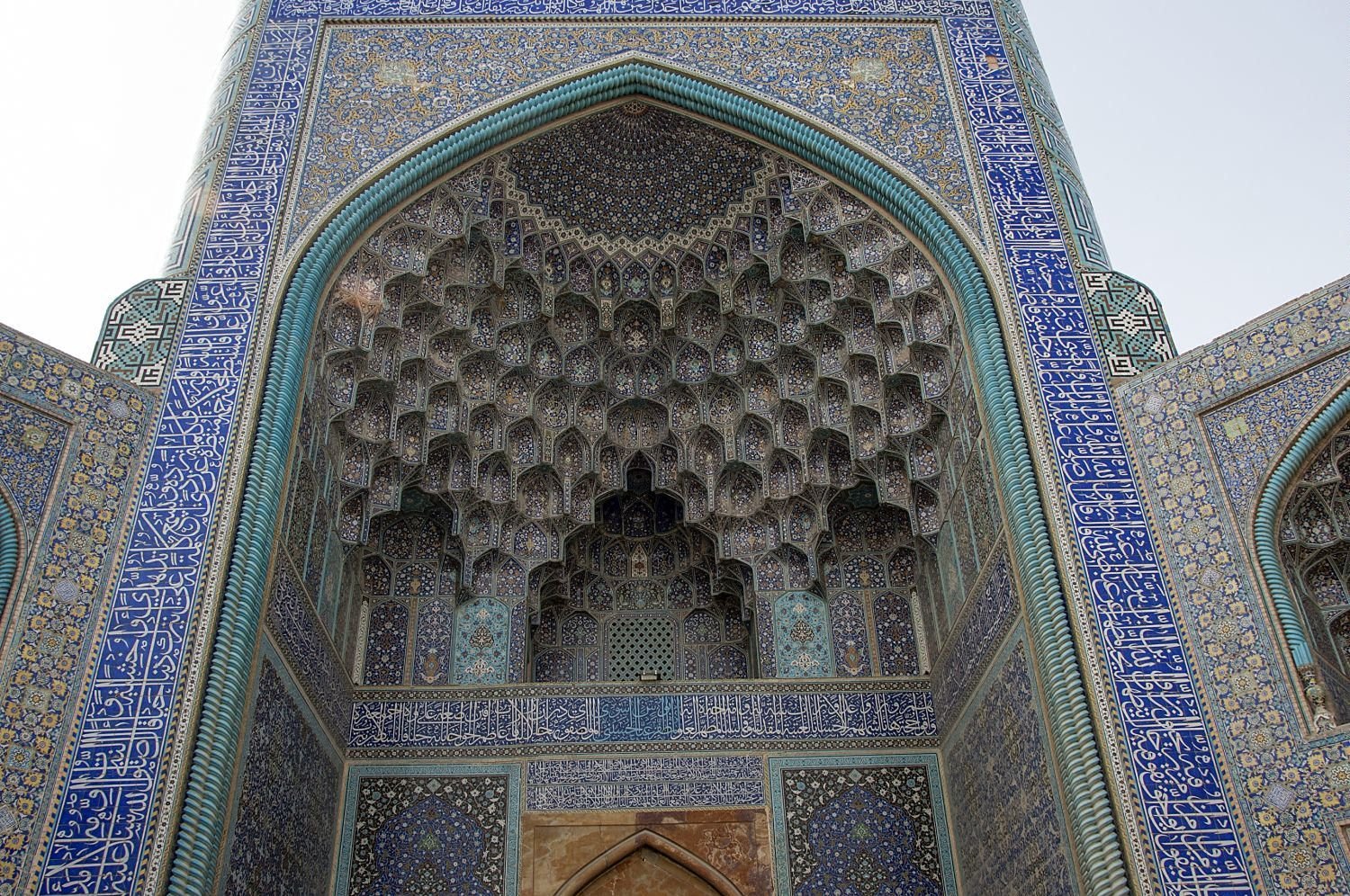
(Masjid-i Imam, Isfahan, Iran, 1611AD Source: Archnet)
Archetypal forms are deeply embedded within Islamic architecture, where intricate detailing plays a fundamental role in articulating spiritual and aesthetic aspects. Among these characteristic elements, muqarnas is a distinctive form that stands out as a significant architectural feature, exemplifying the complexity and symbolic depth of Islamic art and architecture.
Muqarnas (Arabic: مقرنص) is a three-dimensional ornamental architectural element that is used to transform parts of buildings, such as domes, cornices, or vaults, into cascading compositions of light, shadow, and geometry, featuring a honeycomb pattern. Sometimes referred to as a stalactite, muqarnas is among the most captivating decorative forms in Islamic architecture. Beyond decoration, muqarnas serves as a sophisticated structural and symbolic system, reflecting the mathematical skill, spiritual perspective, and artistic mastery of Islamic civilization.
Origins and Historical Development
The exact origin of muqarnas is uncertain, though it is often linked to 10th-century Eastern Persia. However, a 9th/10th-century fragment of carved and painted stucco niches (which are wall recesses usually arched and adorned with intricate and very fine handcarved plaster) with muqarnas was found in Fustat, Egypt. By the 11th century, muqarnas became widely known in the Islamic world, first under the Seljuk dynasty in Anatolia, and later, the technique spread throughout the Islamic world, reaching North Africa, al-Andalus (Islamic Spain), and Central Asia and India. It became a common feature of the decorative arts across the Islamic world, with regional variations shaped by local traditions.
Structural and Aesthetic Function
Muqarnas primarily serves an ornamental function, often used as a cornice to decorate edges and conceal joints, especially on projections. It appears on vaults, domes, pendentives, cornices, corbels, and capitals, and is especially effective for connecting two vertical, non-coplanar surfaces. Muqarnas also addresses the architectural challenge of transitioning from a square base to a circular dome, initially serving as a transition between the squinch or the triangular pendentive and acting as a structural link between cubic and domical sections.
Muslim architects used muqarnas to enhance both interior and exterior transitional zones, blending structural and decorative elements and often creating the illusion of structural support. Aesthetically, muqarnas produces dynamic patterns of light and shadow throughout the day. Its tiered cells reflect sunlight at varying angles, creating a shimmering effect and adding depth and movement to ceilings and vaults.
The materials used for muqarnas construction vary by region. In Syria, Egypt, and Turkey, stone is commonly used, requiring precise craftsmanship. In North Africa, muqarnas are typically made of plaster and wood, whereas in Iran and Iraq, they are constructed of brick and finished with plaster and colored tiles.
Spread Across the Islamic World
During the Seljuk Empire, a Turco-Persian Sunni dynasty that ruled Central Asia and Anatolia between 1037 and 1194 AD, we saw the first introduction of muqarnas in Islamic architecture, which made its design more elaborate. The Seljuk rulers, especially during the 11th and 12th centuries, invested heavily in architectural patronage. Structures such as madrasas, caravanserais, and mosques featured muqarnas in portals, domes, and transitional zones.
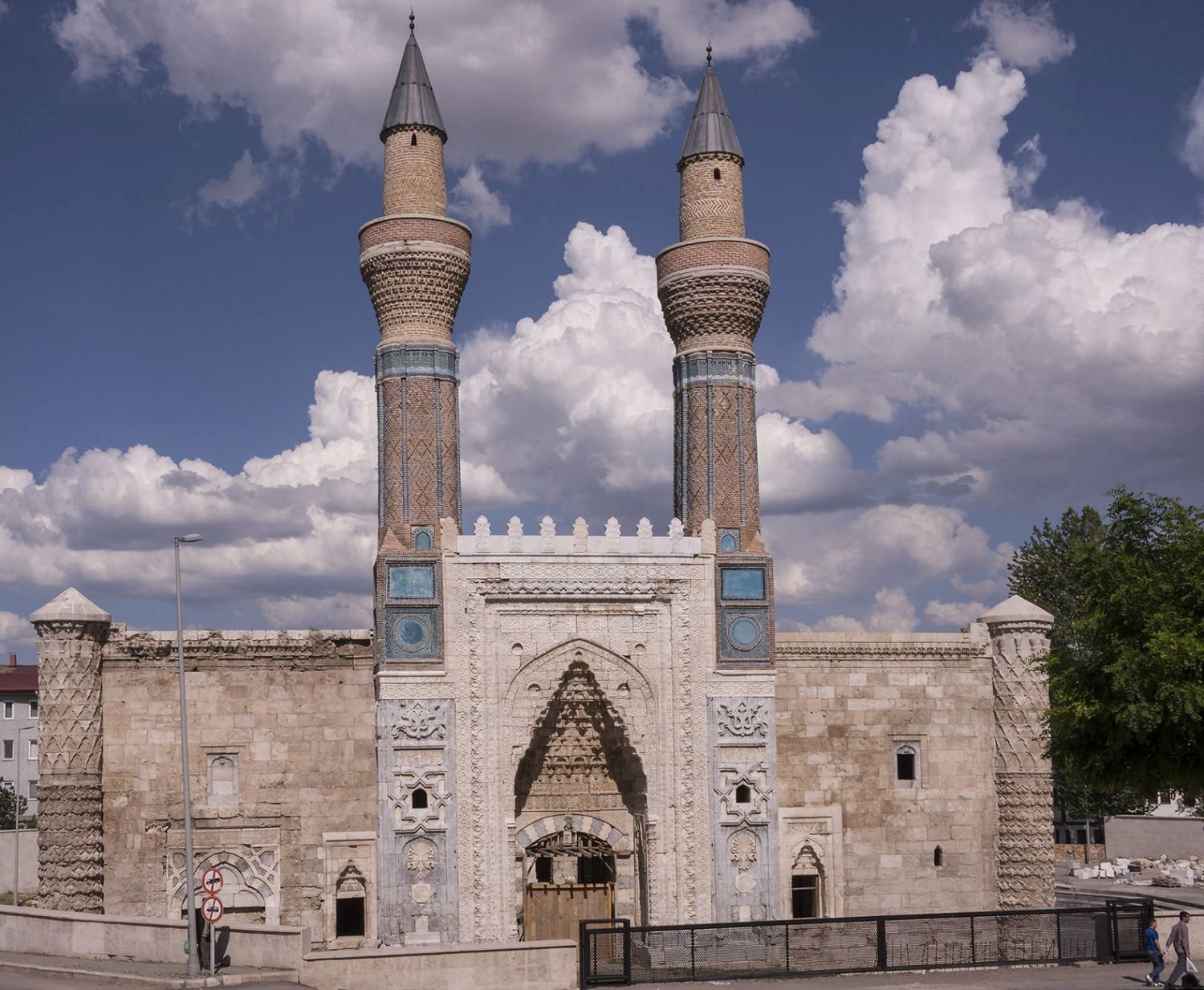 Image: Gök Medrese, Sivas, Türkiye, 1271 AD. Source: Archnet
During the Nasrid dynasty (1232-1492 AD), the last Muslim dynasty to rule Spain, muqarnas achieved remarkable refinement, especially in the Alhambra palaces in Granada, where it was widely employed in domes, vaults, and transitional areas. Muqarnas convert solid surfaces into shimmering geometric cascades, making ceilings appear as symbolic visions of the heavens and emphasizing the delicacy, rhythm, and spiritual grace characteristic of Andalusi art.
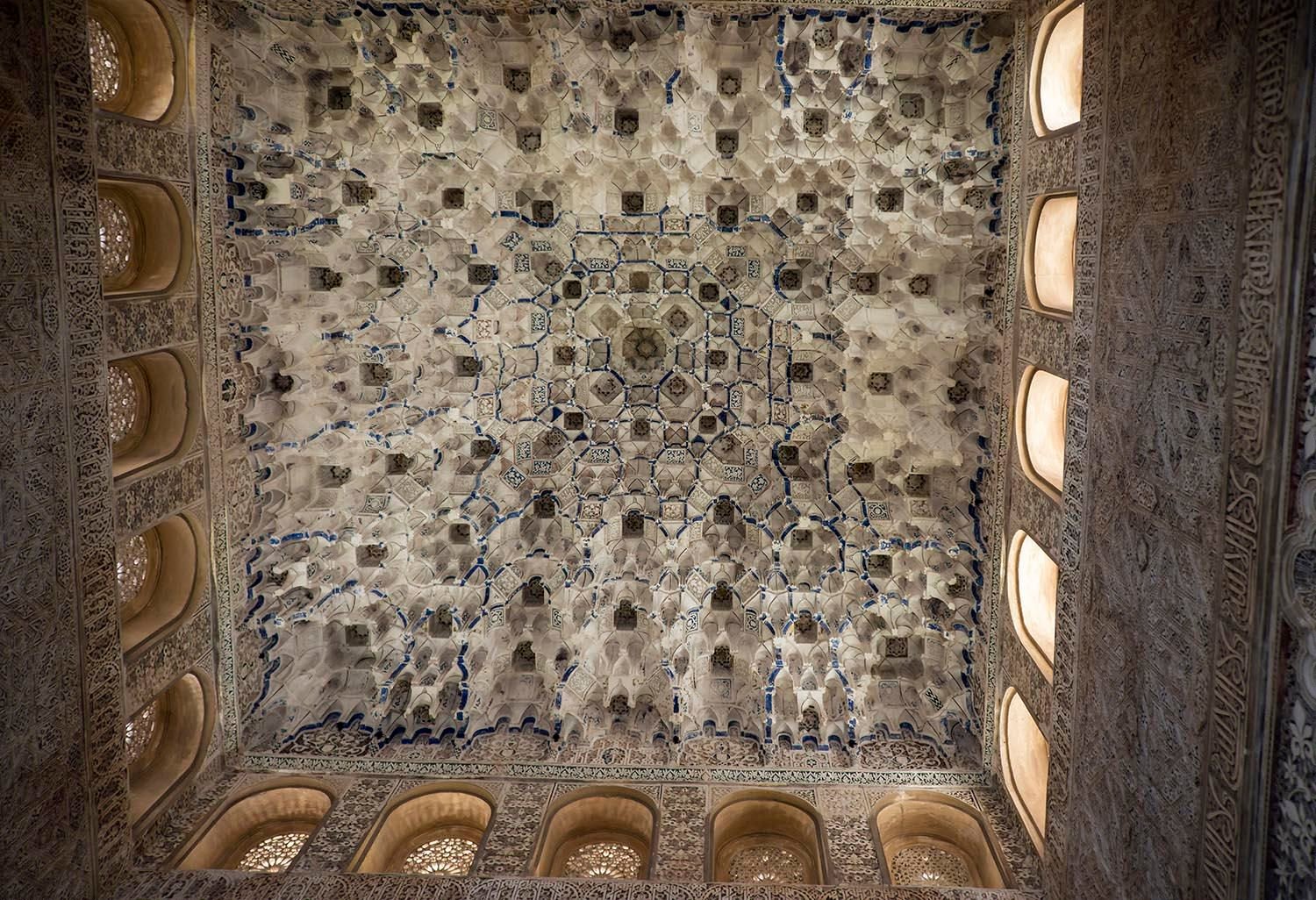 Image: Palacio de los Leones, Granada, Spain, 13th century Source: Archnet
Under the powerful Mamluk Sultanate in Egypt and Syria (1250–1517), muqarnas achieved a high level of sophistication, becoming a key element in religious and civic architecture. Mamluk architects expanded its application from transitional dome zones to include monumental portals, minarets, and interior cornices, focusing on verticality and dramatic surface detail while blending stone carving with intricate geometry. The complex layering of tiers created deep shadows and heightened the visual impact of façades, especially in madrasas and mausoleums, where muqarnas portals symbolized prestige, authority, and architectural skill.
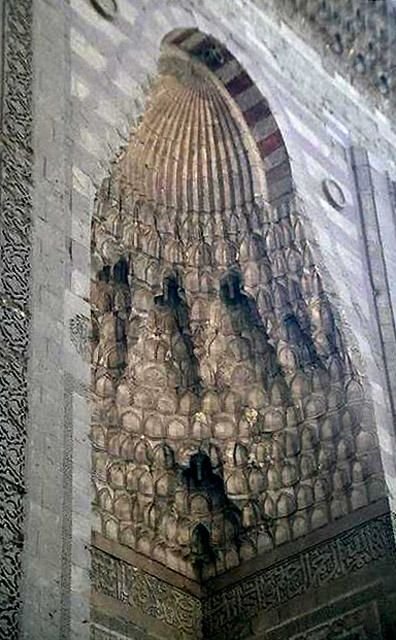 Image: The Complex of Sultan Hasan, Cairo, Egypt, 1356-1363 AD. Source: Archnet
In the eastern Islamic world, in Persia, the Timurid Dynasty (1370-1507), a Turco-Mongol Sunni dynasty founded by Tamerlane, and the latter Safavid dynasty (1501-1736), one of the greatest Shia empires, both adopted muqarnas as a defining element of architecture in Persia. It developed into a sophisticated architectural and decorative technique, utilizing glazed tiles to create lively interiors that seem to meld seamlessly with patterns of light. Especially in Isfahan, muqarnas became more elaborate, featuring detailed geometric patterns and vibrant tilework.
In India, muqarnas was introduced by Islamic dynasties, notably during the Delhi Sultanate (1206-1526) and later the Mughal Empire (c. 1526–1857). Though less prominent than in Persia, it appeared in niches, squinches, and decorative vaults, especially in early Islamic structures. In cities like Delhi and Agra, muqarnas decoration was adapted to local materials such as red sandstone and marble. Gradually, it blended with Indian ornamental styles, contributing to the rich synthesis that defines Indo-Islamic architecture.
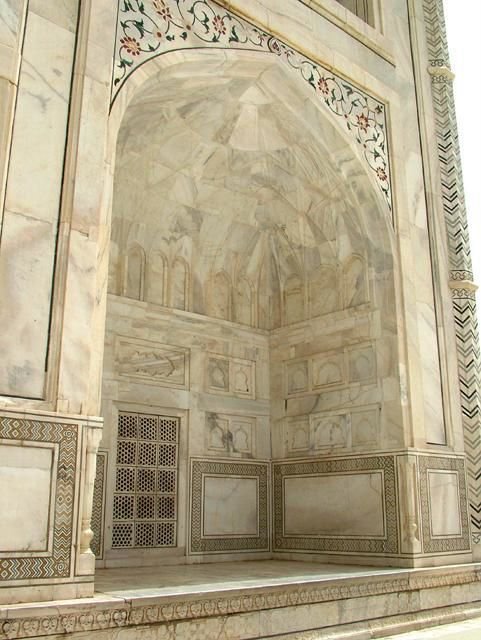 Image: The mausoleum of Mumtaz Mahal, Taj Mahal funerary complex, Agra, India, 1631-1648 AD. Source: Archnet
Muqarnas in Contemporary Architecture
Muqarnas continues to inspire modern architects and designers. In today’s mosque architecture, references to muqarnas act as a link between tradition and innovation. Modern interpretations often abstract the form and incorporate new materials such as steel, glass, and concrete. Parametric design software enables the creation of intricate muqarnas-like structures with remarkable accuracy. A modern example is the Basuna Mosque in a village in Sohag, Egypt. Its mihrab (prayer niche) symbolizes innovation through the reinterpretation of muqarnas. It deconstructs the traditional niche and replaces it with a three-dimensional, modular geometry that holds symbolic and spiritual significance. The design uses the cub, the fundamental unit of the Kaaba (the holiest site in Islam), as its primary building block. It replaces the traditional arched “niche” with a sculptural representation of God’s multiplicity and unity.
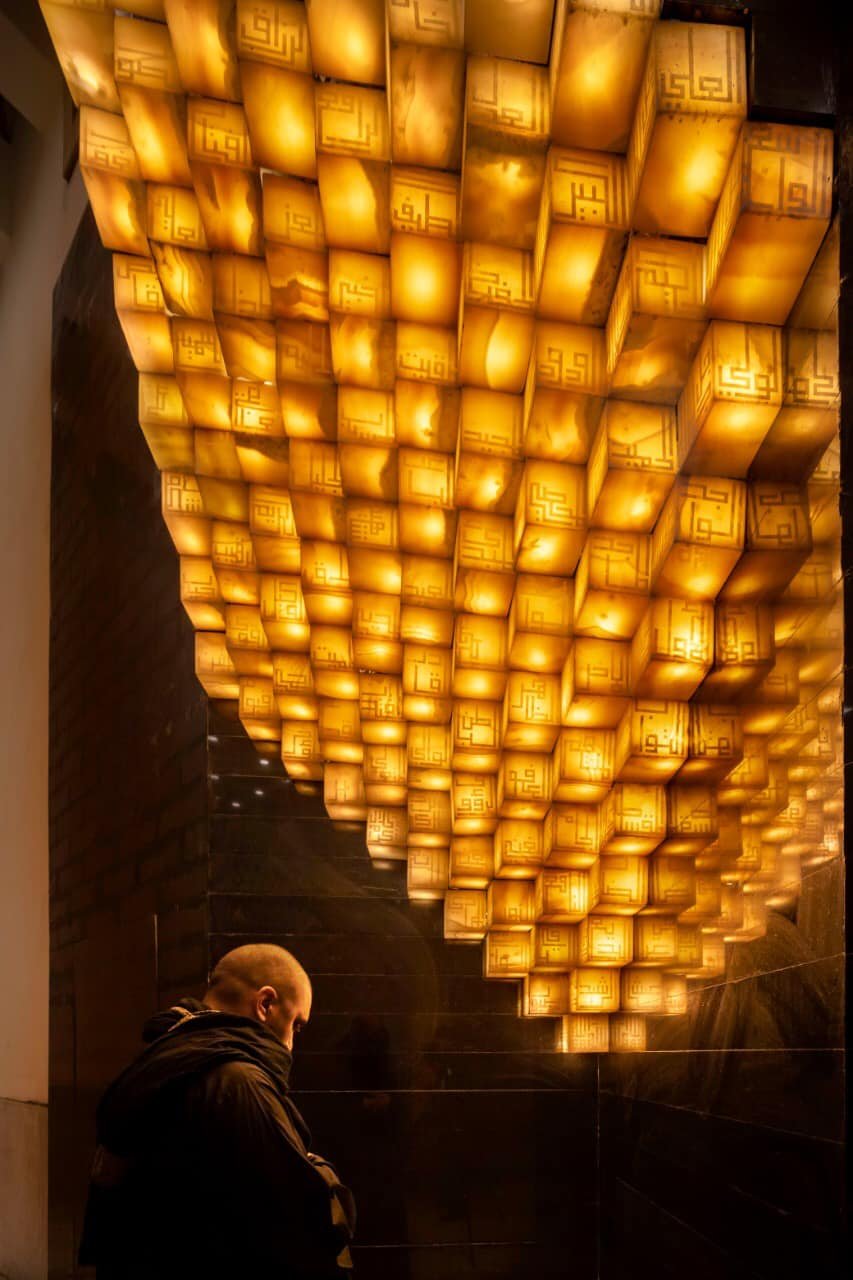 Image: Basunah Mosque, Egypt, by Architect Waleed Arafa. Source:
Dar Arafa Architecture
Muqarnas revolutionized Islamic architecture, starting as a structural solution for transitional spaces and evolving into a renowned decorative element. Its widespread presence over centuries and regions highlights its adaptability and symbolic significance. Muqarnas is more than just decoration; it represents a key aspect of Islamic architectural expression.
References:
Bloom, J. M. (n.d.). The introduction of the Muqarnas into Egypt. In Muqarnas.
Brett, D. (1993). [Review of The Mediation of Ornament, by O. Grabar]. Circa, 65, 63–63.
Garofalo, V. (2011). A Methodology For Studying Muqarnas: The Extant Examples In Palermo. Muqarnas.
Jawad, N. (2019). Reviving the Muqarnas in Damascus: A historical architectural form in a contemporary discourse.
Naz, F. (2024). Muqarnas in Islamic architecture: Development, materials, and techniques. Journal of Art, Architecture and Built Environment, 7(1), 01–16.
Occhinegro, U. (2016). Muqarnas: Geometrical and Stereotomic Techniques in Ancient Islamic Architectures: Ceilings and Domes of Mameluk Buildings in Old Cairo.
(The views expressed in this article are the author’s own. Content can be used with due credit to the author and to ‘Zariya: Women’s Alliance for Dignity and Equality’)
ABOUT THE AUTHOR:
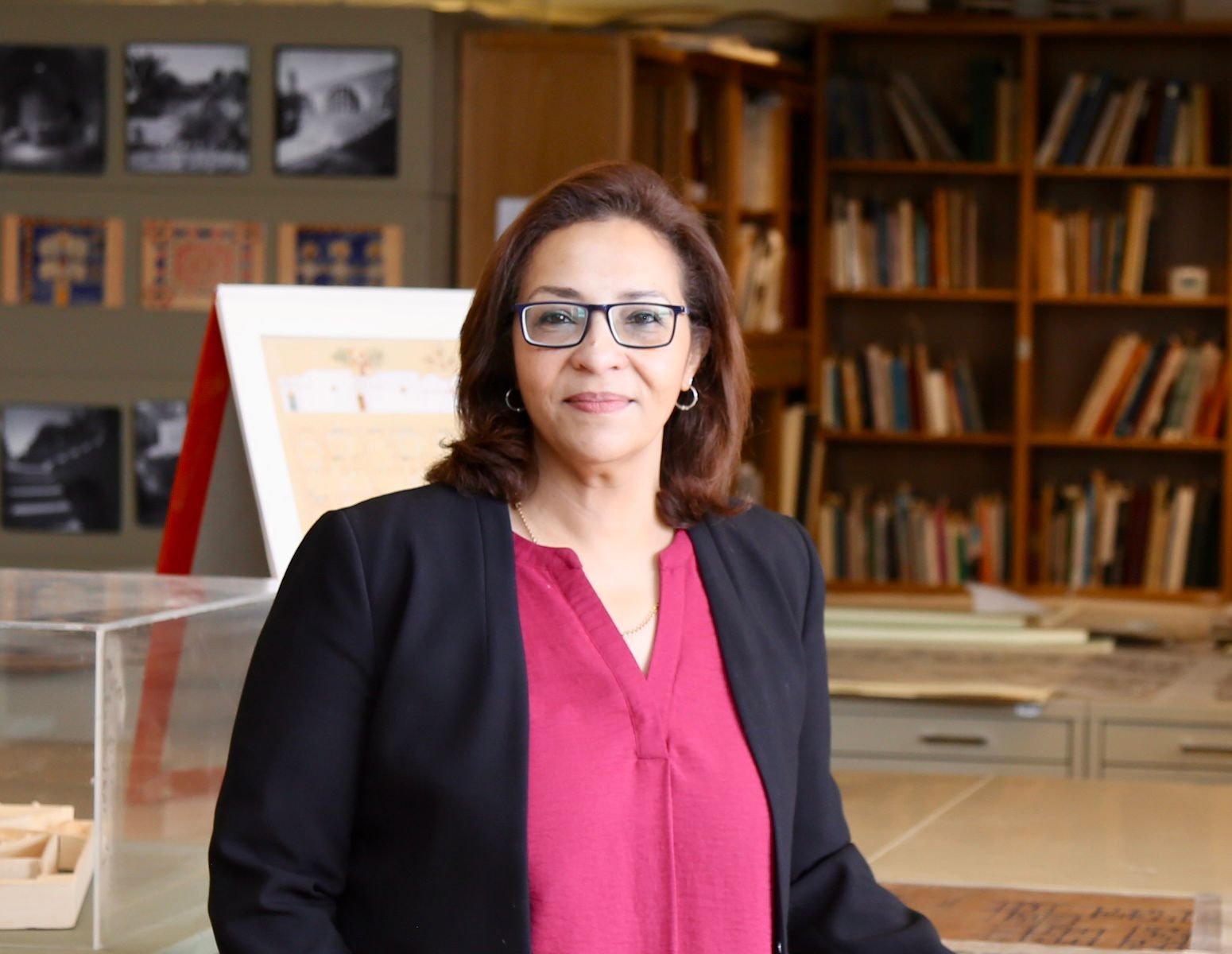
Balsam A. Rahman Saleh is the curator of the architecture collection at the American University in Cairo (AUC). With extensive experience as an architectural historian, Balsam has worked in heritage preservation, monument documentation, and collection management. Prior to her role at AUC, she was associated with the Center for Documentation of Cultural and Natural Heritage (CULTNAT) and the Ministry of Communication and Information Technology. There, she contributed to editing and creating several publications and websites dedicated to Egypt’s heritage.
She holds a master’s degree in Islamic art and architecture from the American University in Cairo and a bachelor’s in interior architecture from Helwan University’s Faculty of Applied Arts.