Humble Majesty: The Artistic and Cultural Legacy of the Bihari Script Qurans
Image source: https://www.christies.com/en/lot/lot-6476563
In the quiet, off-exhibit spaces of the Keir Collection at the Dallas Museum of Art, in Dallas, Texas, a remarkable artifact rests: the Keir 1393 Quran. To the casual observer, it is a 15th-century manuscript defined by simple elegance and understated ornamentation, but, to scholars of South Asian Islamic art, this codex represents a powerful assertion of a uniquely Indian cultural identity during a pivotal transition. The story of the Bihari script begins with the fragmentation of the Delhi Sultanate in India in the late 14th century. Following the devastating invasion of Delhi in 1398 by the Turco-Mongol ruler Timur, a significant population of scholars, artisans, and calligraphers migrated eastward. Many settled in the newly established Sharqi Sultanate of Jaunpur1, which subsequently flourished as a major intellectual and cultural center.
A Script is Born
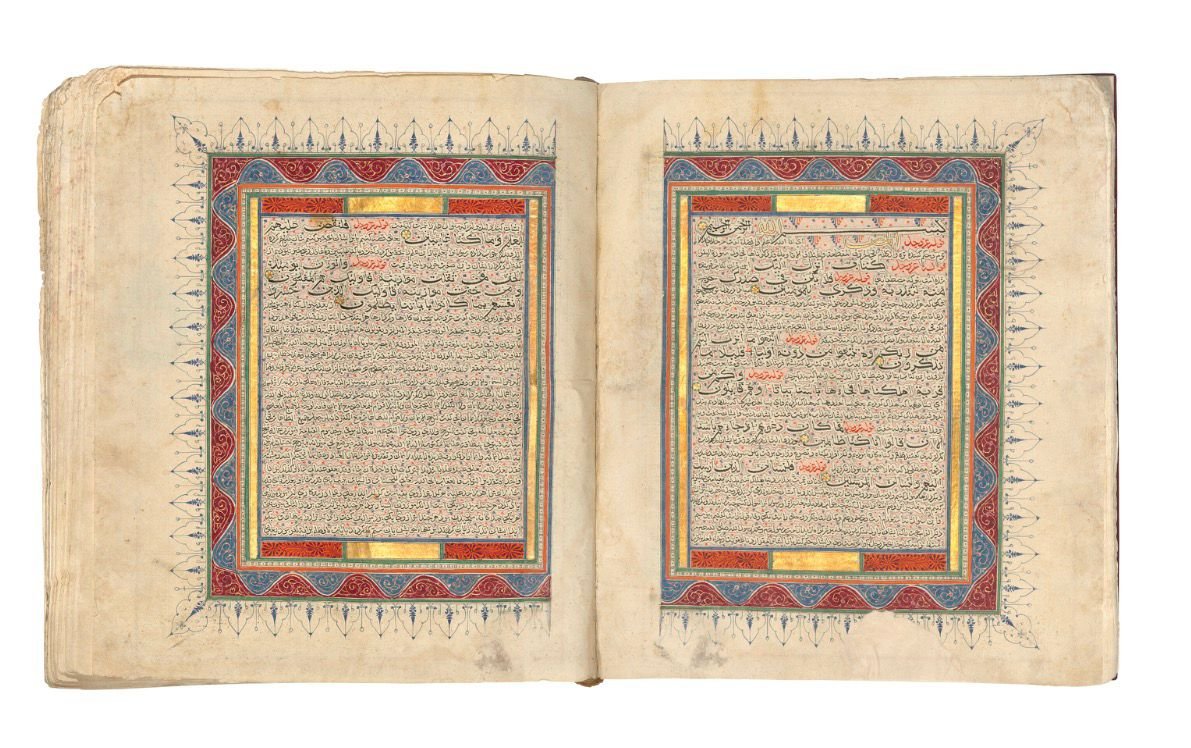
In this diverse environment, where the Delhi Sultanate forms fused with local traditions, the Bihari script was born. Distinguished by its bold, angular letterforms and delicate, “wispy” vertical strokes, the script possesses a distinctive visual rhythm and form. While it shares some formal qualities with the Muhaqqaq script found in Mamluk Egypt, the Indian variant is notably more interwoven, creating a seemingly chaotic but carefully balanced appearance. The intentional use of the Bihari script for copying Qurans, despite the established prestige of other scripts like Naskh, suggests its high value. This script was reserved exclusively for the Arabic verses of the Quran, the most revered text in Islam. The choice reflected a desire by patrons to emphasize their unique cultural identity and status as supporters of the sacred arts. It indicated the script’s importance as a uniquely Indian contribution to the broader Islamic calligraphic tradition.
The Language of Power and Piety
Understanding these manuscripts requires examining the linguistic environment in the Sharqi Sultanate during whose rule the Bihari script Qurans appeared. The Persian language had become the language of the court and the elite, introduced to India through centuries of Persian cultural exchange and conquest. It symbolized sophistication and authority. By the 15th century, Persian had firmly established itself as the lingua franca of India, used for administration, culture, and scholarship. Complementing the bold Bihari script in these Qurans was the use of a Naskhi-Divani hybrid script for interlinear translations and marginal annotations in Persian. As Islam spread to non-Arabic-speaking regions, these bilingual manuscripts became essential for providing local Muslims with a deeper understanding of the divine text. The use of Persian alongside Arabic reinforced the legitimacy of the text as part of the Sultanate’s high regard for culture and enhanced the reader’s spiritual connection to the Quran through Persian, a language that was understood locally.
A Tool for Education and Recitation
Beyond their beauty, Bihari script Qurans were functional, likely utilized in madrasas (educational institutions) and Sufi shrines. Small red or blue letters were often added to indicate alternative vocalization marks or variations in pronunciation distinct from the Uthmanic standard2. These marks appear to form an abbreviation system linked to specific Quranic readers or reciters, reflecting the instructional nature of these manuscripts. Furthermore, the outer frames of the pages contained marginal glosses featuring hadiths (sayings and actions of the Prophet Muhammad, PBUH), sacred benefits of certain texts, and instructions on ritual acts like prostration. The complex, zigzagging arrangement of these glosses clearly distinguished the sacred Arabic text from its translation and commentary. This reflects a deliberate effort to integrate the Quranic verses with a comprehensive interpretative framework for a diverse audience.
The Sultanate’s Cultural Tapestry
The ornamentation of these Qurans offers a glimpse into the multicultural world of the Sharqi Sultanate of Jaunpur, India. Artists integrated motifs from a vast transregional network, including Mamluk, Ottoman, and Jain designs. Mamluk influence is evident in the Keir 1393 Quran through its golden Rumi-style borders against ultramarine backgrounds, a design fashionable in mid-14th-century Egypt. These styles merged with distinctly Indian elements, such as long-petaled lotus bud floral designs similar to those found in Jain manuscript traditions. In both Indo-Persian and Jain traditions, these lotus buds often shared a color scheme of red and yellow hatching, a technique appearing as early as 11th-century Rajasthani manuscripts. The merging of artistic traditions reflected the Sultanate’s distinct cultural identity and its role as a major center of cultural convergence.
Spiritual Sovereignty: The Role of the Sufis
The production of these high-quality manuscripts also served a political strategy. In medieval India, Sufi shaikhs (religious leaders) wielded tremendous moral authority and were believed to possess spiritual sovereignty that could provide moral legitimacy to Muslim rulers. By commissioning beautifully written and decorated Qurans for Sufi hospices and shrines, the ruling elite of the Sharqi Sultanate sought to gain favor with these influential leaders and their followers. The intertwining of political authority and Sufi spiritual influence legitimized Sharqi rule and integrated the dynasty into the spiritual and cultural fabric of the region. By fostering a distinctively Indian style of calligraphy, the Sharqi rulers secured a lasting legacy that distinguished their rule from those that came before or after.
A Lasting Legacy
Today, the Bihari script remains an understudied facet of South Asian Islamic art. Yet, manuscripts like the Keir 1393 Quran stand as a testament to a time when Jaunpur, the capital of the Sharqi Sultanate, was celebrated as the “Shiraz of India,”3 a major political and cultural hub. Through their blend of diverse calligraphic styles, bilingual translations, and multicultural motifs, the Bihari script Qurans capture the intellectual and artistic ambitions of a dynasty that sought to create something truly and uniquely Indian. The Quran reminds us that even in a sacred text, there is room for a quiet, simple beauty that speaks across centuries and cultures.
Footnotes:
- The Sharqi Sultanate emerged in 1394 as the Delhi Sultanate declined, when Malik Sarwar, an Abyssinian slave who rose to high office, established independent rule over the eastern provinces of India. From his capital at Jaunpur, later rulers such as Ibrahim Shah Sharqi transformed the city into a major political and cultural center known as Shiraz-e Hind.
- The Uthmanic standard was based on the precise and carefully synchronized Quranic recitation of the ProphetMuhammad, believed by Muslims to have been divinely guided by the Archangel Jibreel(Gabriel) on the authority of God.
- Shiraz-e Hind (Persian: “Shiraz of India”) was a title given to Jaunpur by the Mughal emperor Shah Jahan, comparing the city’s flourishing culture and scholarship to that of Shiraz, the celebrated cultural capital of the Persian world. The designation reflects Jaunpur’s reputation as a major center of learning, arts, and intellectual life during the rule of the Sharqi Sultanate.
References
- Ali Andrabi, Syed Damsaz. “Sufism: Origin and Basic Concepts.” International Journal of Culture and History 2, no. 1 (2015): 30. https://doi.org/10.5296/ijch.v2i1.7597
- Askari, Syed Hasan. “Discursive Notes on the Sharqi Monarchy of Jaunpur.” Proceedings of the Indian History Congress 23 (1960): 152–63. http://www.jstor.org/stable/44304055
- Blair, Sheila. Islamic Calligraphy. Paperback edition. Edinburgh: Edinburgh University Press, 2008. https://www.jstor.org/stable/10.3366/j.ctvxcrjn5
- Brac De La Perrière, Eloïse. “Bihârî et naskhî-dîwânî: Remarques sur deux calligraphies de l’Inde des sultanats: Écriture, calligraphie et peinture.” Studia Islamica 96 (2003): 81–93.
- Brac De La Perrière, Eloïse. “Manuscripts in Bihari Calligraphy: Preliminary Remarks on a Little-Known Corpus.” Muqarnas 33, no. 1 (2016): 63–90. https://doi.org/10.1163/22118993_03301P005
- Brac De La Perrière, Eloïse, and Brill. “Bihārī Calligraphy.” In Encyclopaedia of Islam, THREE, 2020. https://doi.org/10.1163/1573-3912_ei3_COM_35504
- Chaigne, Frantz, and Mathilde Cruvelier. “The Ornamentation of the Gwalior Qurʾan, Between Diachronic Legacies and Geographic Confluences.” In Le Coran de Gwalior: PolyséMie d’Un Manuscrit à Peintures, 17–56, 2016.
- Eaton, Richard Maxwell, and University of California Press. India in the Persianate Age 1000-1765. Oakland, California: University of California Press, 2019.
- Ettinghausen, Richard. 1977. Arab Painting. [Geneva?], New York: Skira ; Rizzoli.
- Flood, Finbarr Barry. “Before the Mughals: Material Culture of Sultanate North India.” Muqarnas 36 (2019): 1–39.
- Flood, Finbarr Barry. “Eclecticism and Regionalism: The Gwalior Qur’an and the Ghurid Legacy to Post-Mongol Art.” In Le Coran de Gwalior: PolyséMie d’Un Manuscrit à Peintures, 153–70, 2016.https://doi.org/10.2307/j.ctvbqs3d9.14
- Hussain, Syed Ejaz. Shiraz-I Hind: A History of Jaunpur Sultanate. New Delhi: Manohar, 2017.
- Khatib, Ammar, and Dr. Nazir Khan. “The Origins of the Variant Readings of the Qur’an.” Yaqeen Institute for Islamic Research, July 22, 2024. https://yaqeeninstitute.org/read/paper/the-origins-of-the-variant-readings-of-the-quran
- Malik, Jamal. “Muslim Heterogeneity: Margins Becoming Centres of Muslim Power (Approx. 1300–1500).” In Islam in South Asia, revised, enlarged, and updated second edition, 2020. Leiden: Brill. https://brill.com/abstract/title/56839
- Muravchick, Rose E. “Objectifying the Occult: Studying an Islamic Talismanic Shirt as an Embodied Object.” Arabica 64, no. 3–4 (2017): 673–93. https://doi.org/10.1163/15700585-12341464
- Naqvi, Mahdi. “Spaces of Lamentation in North India: The Sharqi Imambaras.” Proceedings of the Indian History Congress 79 (2018): 231–39. https://www.jstor.org/stable/26906251
- Parikh, Rachel. “Falnama.” Khamseen: Islamic Art History Online, published 17 December 2024.
- Rice, Yael. The Brush of Insight: Artists and Agency at the Mughal Court. Seattle: University of Washington Press, 2023. https://search.ebscohost.com/login.aspx?direct=true&scope=site&db=nlebk&db=nlabk&AN=3610295
- Robinson, Francis. The Mughal Emperors and the Islamic Dynasties of India, Iran, and Central Asia, 1206-1925. New York: Thames & Hudson, 2007.
- Shah, Midhat. The Harmonious Tapestry: The Influence of Sufi Thought on South Asian Literary and Aesthetic Traditions. 2024. https://doi.org/10.2139/ssrn.5008425
- Talisman | Definition in the Cambridge English Dictionary. Accessed May 12, 2025. https://dictionary.cambridge.org/us/dictionary/english/talisman
(The views expressed in this article are the author’s own. Content can be used with due credit to the author and to ‘Zariya: Women’s Alliance for Dignity and Equality’)
About the Author
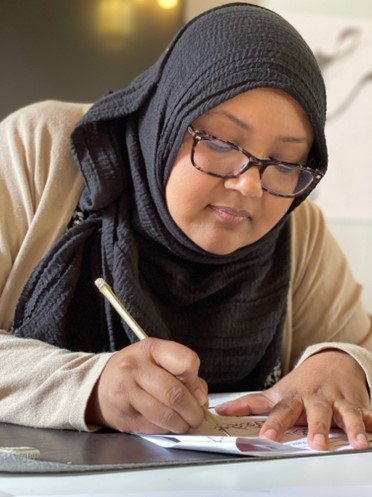
Farzana Razzaque is a Bangladeshi-American Arabic calligrapher and illumination artist trained in the Ottoman tradition. A graduate of the School of Architecture at the University of Texas at Austin, she has devoted over a decade of her life to the rigorous study of Islamic calligraphy and tezhip (illumination). She holds ijazahs (authorizations) in Thuluth and Naskh scripts from Master Calligrapher Haji Noor Deen, as well as in Riq‘a, Diwani, and Diwani Jali scripts from Master Calligrapher Shahrayanshah Sirajuddin. Grounded in classical technique yet engaged with contemporary concerns, Farzana’s practice explores themes of colonialism, diaspora, social memory, and the lived experiences of Muslim communities, extending calligraphy into fabric, performance, and sculptural forms. A former Program Director at the Deen Arts Foundation, she is currently pursuing a Ph.D. at the University of Texas at Dallas, where her research examines the evolution of calligraphy and the contemporary mus’haf in South Asia, as well as the role of the Quran in diaspora.
She holds ijazahs (authorizations) in Thuluth and Naskh scripts from Master Calligrapher Haji Noor Deen, as well as in Riq‘a, Diwani, and Diwani Jali scripts from Master Calligrapher Shahrayanshah Sirajuddin. Grounded in classical technique yet engaged with contemporary concerns, Farzana’s practice explores themes of colonialism, diaspora, social memory, and the lived experiences of Muslim communities, extending calligraphy into fabric, performance, and sculptural forms.