Abu al-Dahab Mosque in Collective Memory
‘Stone, Gold, and the Absence of Baraka: The Silent Legacy of Abu al-Dahab’
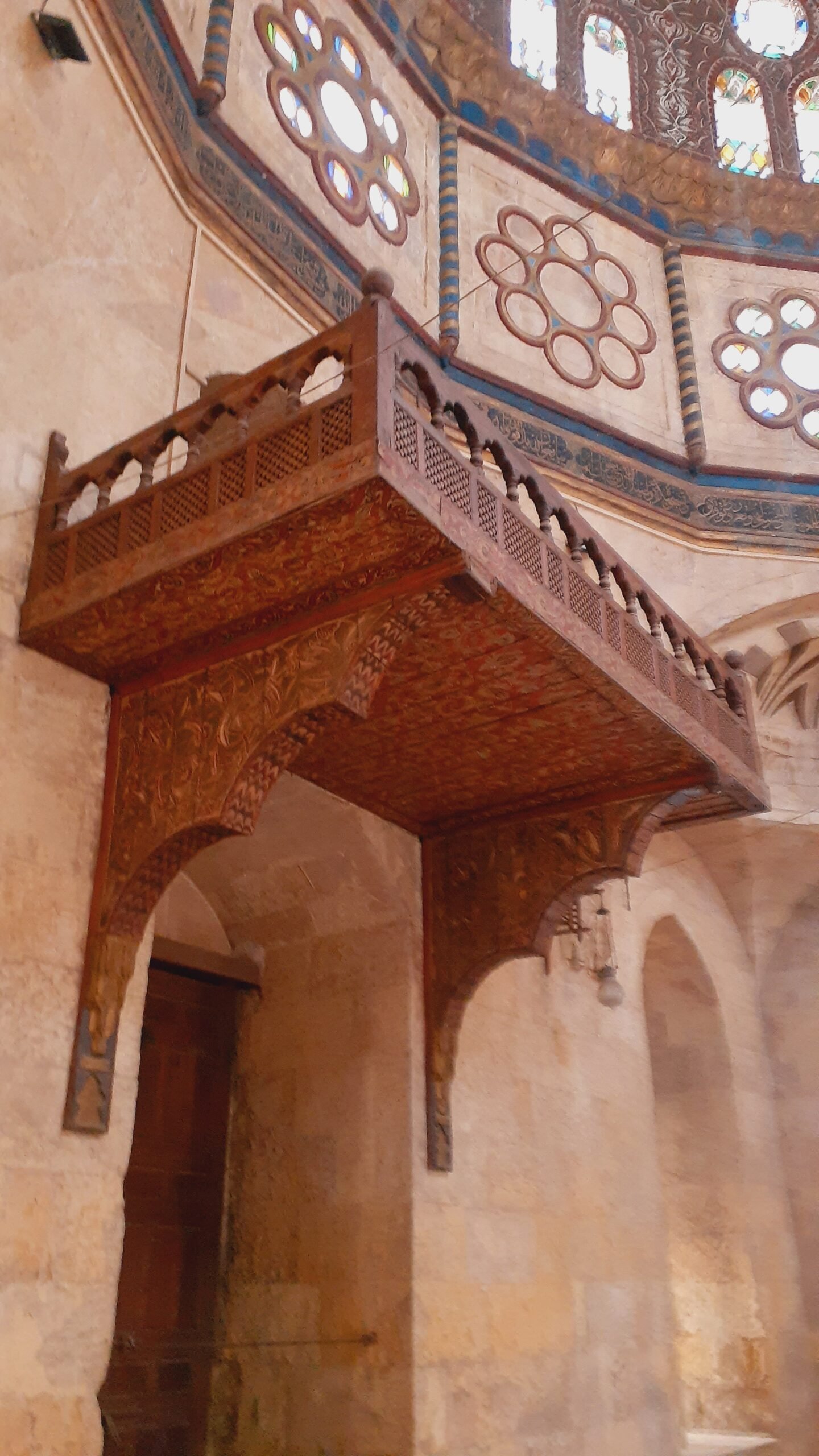
In the heart of historic Cairo, just steps away from the venerable Al-Azhar Mosque, the complex of Muhammad Bey Abu al-Dahab mosque stands as an extraordinary case study embodying the conflict between the materiality of architecture and the vitality of collective memory. (First pic- The beautifully decorated wooden Dikkat al-Muballigh (chanter’s platform) beneath the dome.(Pic Credit- Adel Moussa). Despite the grandeur of its construction and the uniqueness of its minaret—reflecting a political ambition to rival the scholarly centrality of Al-Azhar—the current state of the mosque, as a functionally suspended space, raises profound questions about the concept of “Baraka” (blessing) in the popular imagination. The silence enveloping the mosque’s hallways transcends mere functional vacancy; it has transformed into an “act of symbolic resistance” maintained by the community over centuries. Thus, the mosque is no longer just an urban achievement from the Ottoman era; it has become a living “popular document,” proving the community’s power to strip an artifact of its sanctity if it is associated in their minds with the injustice of authority or the assassination of moral legitimacy as will be described in the article below.
Construction and Architecture: A Masterpiece in the Ottoman Era
The Mosque of Muhammad Abu al-Dahab is an architectural masterpiece of the Ottoman era in Egypt. Construction began in 1187 AH (1773 AD) and it was inaugurated with Friday prayers in Sha’ban 1188 AH (1774 AD). The mosque follows the distinct “Rumi” (Istanbul) style, making it the fourth mosque in Cairo built on the model of Istanbul’s great mosques, following the mosques of Sulayman Pasha in the Citadel, Sinan Pasha in Bulaq, and Queen Safiya in Al-Darb al-Ahmar.
The mosque is distinguished as a “suspended” (mu’allaq) mosque, accessed via a flight of stairs, and takes a rectangular form. The design consists of a large central dome surrounded by three porticos covered by groups of smaller domes supported by marble columns. The mihrab 1 is located in the southeastern part of the mosque, while the main dome sits at the center of the court, featuring several windows with stucco and stained glass that cast multicolored light onto the mosque floor.
The Abu al-Dahab complex was not limited to the mosque alone; he attached a library containing approximately 650 rare and valuable books across various fields. He also added a Takiyya (hospice) for Turkish Sufis, a Sabil (drinking fountain) for passersby, and a trough for watering animals, rendering the complex a comprehensive urban center.
The Minaret and Popular Legend: The Enchanted Jars of Gold
The minaret of the Abu al-Dahab Mosque is characterized by an unusual shape, consisting of three levels ending in five heads—closely resembling the minaret of the Qansuh al-Ghuri Mosque.The significance of this design lies in its architectural rarity and symbolic connection to the late Mamluk style. By mirroring the five-headed minaret of Qansuh al-Ghuri, it creates a visual and historical dialogue between the two complexes. This unique structure highlights the mosque’s prominence in Cairo’s skyline and reflects Abu al-Dahab’s desire to align his monument with the grandeur of the Great Mamluk Sultans.
This distinctive form became associated with a popular legend passed down through generations in Historic Cairo.
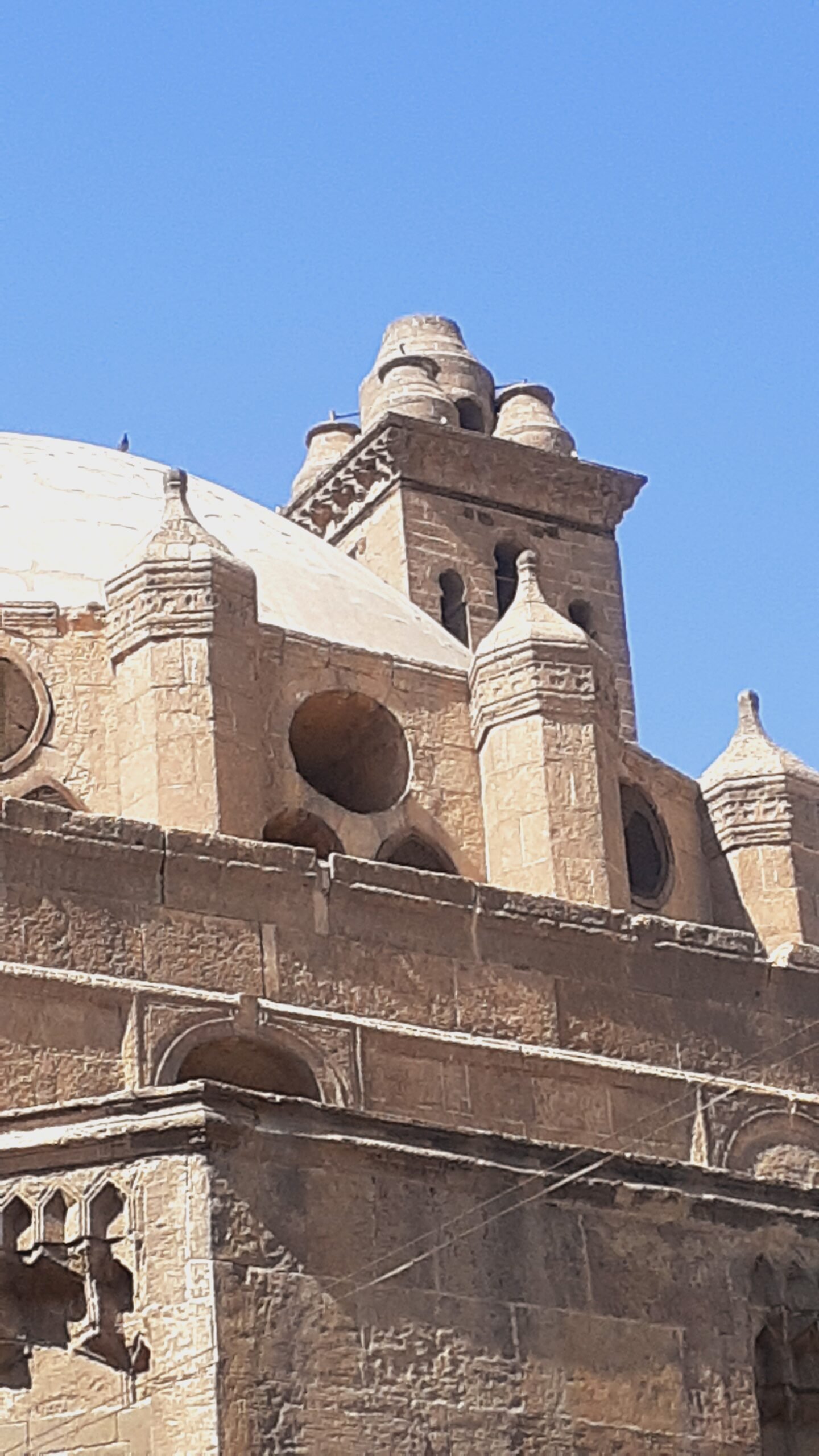
Close-up view of the mosque’s dome and its distinctive minaret. Pic- Adel Moussa
The legend states that the minaret is guarded by supernatural magical forces protecting four clay jars (azyar) at its summit, filled with pure gold. These jars are guarded by a massive serpent that prevents anyone from approaching or seizing the treasure unless a precise and nearly impossible condition is met: the seeker’s name must be “Muhammad,” as must his father’s, his grandfather’s, and so on, back to the seventh ancestor.
Popular tales abound of men who attempted to seize this wealth, only to meet their deaths because the name “Muhammad” did not recur in their lineage beyond the fourth or fifth ancestor. This legend symbolically reflects the collective memory’s refusal to grant legitimacy to the mosque’s founder; just as fulfilling the condition to claim the treasure is impossible, so too is the fulfillment of the conditions for “Baraka” and spirituality in a mosque built by a treacherous oppressor.
Muhammad Bey Abu al-Dahab: From Servitude to Betrayal
To understand the story of this prayerless mosque, one must first understand the man who built it. Muhammad Bey Abu al-Dahab was born in 1735 in the North Caucasus and was kidnapped as a child from his Abkhazian or Circassian family to be sold in the slave market. He became a Mamluk2 of Ali Bey al-Kabir, who was then the Sheikh al-Balad (Leader of the Country). Raised by Ali Bey, Abu al-Dahab shared in his military and political achievements, eventually reaching the position of Khazindar (Treasurer). It is said that his joy at this appointment led him to march in a great procession, scattering gold and gifts to the people, which earned him the title “Abu al-Dahab” (Father of Gold). Yet, beneath this external display of loyalty, Abu al-Dahab concealed a complex personality harboring fierce political ambition and sharp contradictions in loyalty.
The Grand Betrayal: Turning Against the Master
The peak of Abu al-Dahab’s treachery occurred when he led a successful military campaign to control the Levant on behalf of his master. This victory was a severe blow to the Ottoman State, representing a potential resurgence of the Mamluk state. Here, the Ottoman Sultanate intervened, offering Abu al-Dahab the governorship of Egypt and the influence his master had seized, on the condition that he turn against Ali Bey al-Kabir.
Abu al-Dahab agreed to the betrayal and returned his army to face his master. In the decisive Battle of Salhiya in 1772, Abu al-Dahab was victorious. He eventually captured Ali Bey in Al-Arish, poisoned him, and killed him. Having eliminated his master, Abu al-Dahab appointed himself Sheikh al-Balad and communicated with the Sublime Porte in Istanbul to be appointed Wali of Egypt, which was achieved by a Sultanic decree in 1773.
The Mosque and the Curses: Al-Dardir vs. Abu al-Dahab
In the same year he took power, Abu al-Dahab began building his lavish mosque facing Al-Azhar, with the clear aim of rivaling Al-Azhar’s scientific and religious status. However, Cairenes resisted this ambition by boycotting the new mosque. Abu al-Dahab was forced to summon the greatest scholars of the time to teach there, such as Sheikh Ahmed al-Dardir3 who eventually cursed Abu al-Dahab and departed.
Popular narratives recount a striking story regarding Al-Dardir’s stance. Invited to the inauguration banquet, the Sheikh discovered the meat served was dog meat. When Abu al-Dahab mockingly called him “Abu al-Karamat” (Owner of Miracles), Al-Dardir reportedly squeezed the rice served with the food, and blood dripped from it. He told Abu al-Dahab: “This is the blood of the victims of your building,” and then commanded the roasted dog to stand, which it did, running before the attendees. Following this “miracle,” Al-Dardir cursed Abu al-Dahab and departed.
Abu al-Dahab remained in power for only two years, during which he earned the hatred of Egyptians who dubbed him “The Bloody One.” He died of a sudden fever in Palestine at the age of forty-one. People believe his death was the result of Sheikh al-Dardir’s curse. His body was carried to Cairo to be buried within the mosque he built, where his tomb remains today.
Symbolic Protest and Moral De-legitimization
The popular narrative of the clash between Sheikh al-Dardir and Abu al-Dahab represents the pinnacle of symbolic protest in the Cairene conscience. The story transcends its “miraculous” nature to become a tool for stripping moral legitimacy from authority. From a socio-cultural perspective, the choice of the “dog” in the popular imagination was not random, but an intentional insult to the authoritarian symbol, linking his architectural achievement to profound ritual impurity—thus justifying the later practice of the “ritual boycott” of prayer in the mosque.4
Popular Memory and the Eternal Curse
Despite administrative reasons for the mosque’s current closure (it is managed by the Ministry of Tourism and Antiquities as an archaeological site), the collective conscience insists on a moral explanation. A local narrator (Abdul Nabi) summarizes this view: People do not forget the oppressor… God strips the blessing from his legacy, so the mosque stands silent so its owner may not receive the reward of prayer. This reflects how society interprets administrative measures as an extension of the “stripping of Baraka.”
Conclusion: The Resilience of Memory
The architectural complex was designed to be more than just a place of worship; it was a sophisticated urban center. Documents indicate that it contained a mosque, a madrasa (religious school), a tekke (Sufi lodge), a sabil (public fountain), and a library. Its artistic and functional grandeur was intended to secure the legacy of Abu al-Dhahab. Endowment records show generous funding for these services, including salaries for librarians and support for Sufi students. Yet, despite this enormous investment in art and social welfare, the complex failed to achieve the “baraka” (blessing) or popular acceptance envisioned by its founder. In Cairo’s collective memory, the stone’s magnificence remained overshadowed by the injustice of its builder, leaving the mosque a silent masterpiece that highlights the tension between material splendor and moral legitimacy. This failure to win the hearts of the people is what makes the intangible heritage in this research a “history written from below”—a history written not merely from official history, but a critical tool that refuses to separate blessing from justice. Here, popular memory proves its power to strip the stone of its sanctity by interpreting its current silence as a moral retribution against its builder. This transforms the mosque into a unique cultural laboratory for studying the resilience of memory in the face of forced commemoration through stone and gold.
Footnotes:
- Mihrab is a niche in the wall of a mosque that indicates the direction of the Kaaba in Mecca towards which Muslims face when offering their prayers.
- “In this context, a ‘Mamluk’ refers to a member of a military caste of formerly enslaved individuals who were brought to Egypt, converted to Islam, and underwent rigorous military and administrative training. Unlike traditional hereditary nobility, the Mamluk system was based on a unique hierarchy of loyalty and merit. As a Mamluk of Ali Bey al-Kabir, Abu al-Dahab was not merely a servant, but a protégé being groomed for high-ranking political and military leadership.
- https://www.scribd.com/document/360721105/Imam-Dardir-Biography
- The choice of a ‘dog’ in the folk narrative serves a specific analytical purpose. In the cultural context of that era, it was a powerful symbol used to project ‘ritual impurity’ onto the ruler’s achievement. By doing so, the community created a moral and religious justification to ‘boycott’ the mosque, effectively stripping Abu al-Dahab of his legitimacy. This isn’t just a story about a dog; it’s a documentation of how the public used symbolic protest to challenge authority.
References:
- Al-Jabarti, A. (1879). Merveilles biographiques et historiques (Aja’ib al-Athar fi al-Tarajim wa al-Akhbar). Bulaq Press. Cairo.
- Maher, S. (1983). Mosques of Egypt and Their Righteous Saints. Supreme Council for Islamic Affairs, Ministry of Endowments. Cairo.
- Moussa, A. (2026). Biography of the Owners of Mosques. Bait al-Hikma for Publishing and Distribution. Cairo.
(The views expressed in this article are the author’s own. Content can be used with due credit to the author and to ‘Zariya: Women’s Alliance for Dignity and Equality’)
About the Author
Adel Moussa is a cultural heritage specialist and a facilitator for the UNESCO 2003 Convention for the Safeguarding of the Intangible Cultural Heritage. He is the Director of the Nubian Heritage Society and a specialist at the Bibliotheca Alexandrina. Moussa has led several UNESCO-affiliated national inventory projects, including the documentation of traditional crafts in Historic Cairo. He is the author of “The Biography of Mosque Owners” (2026) . He is currently pursuing a Master’s degree at the Faculty of African Postgraduate Studies, Cairo University.