Shared Sacred Landscapes: Lebanon’s Druze Maqām of Al-Sharīf and Its Muslim and Christian Parallels
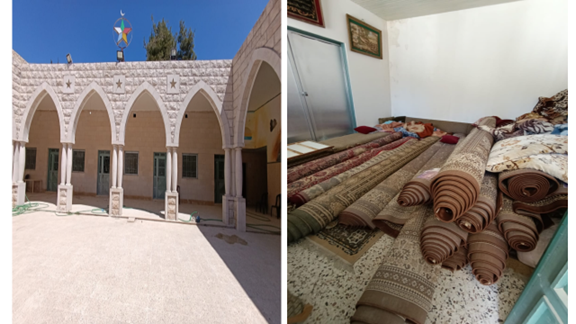
Maqām al Sharīf, Northern Portico, Photo: Rima Barakat: April 2024
The Druze faith is a monotheistic religion that emerged in the 11th century in Egypt during the reign of the Fatimid caliph Al-Hakim bi-Amr Allah. Because this religion diverged from mainstream Islamic doctrine, the Druze were discriminated against, historically and even at present. Though the Druze is a religion which essentially bifurcates from Islam, it tries to identify itself with it. This piece sheds light on the similarities Druze shrines have with Muslim ones in structure as well as in rituals. As the Druze have been historically persecuted and since the Druze practice taqiyya or assimilation with Islam, they try to mirror their Muslim counterparts in the architectural structures of their maqāms1, as well as in the rituals that are practiced. Still, they stand out in many aspects unique to their religion. Moreover, some habits followed by Druze in these mazārs or shrineS or sanctuaries are also similar to those followed by their Christian counterparts. This paper shows that similarities connecting Druze maqams to their Muslim counterparts in Lebanon exist, but differences between them are also discernible.
There are many Druze maqams in Lebanon, seven well-known large ones and numerous small ones. These seven maqams, six of revered Druze men and one of a pious Druze woman, contain the remains of revered Druze men and women who endured many hardships but never relinquished their faith. Other small Druze maqams built by families for their private use are sprouting around the country too. Although these small maqams contain the tomb of a pious religious person in the family, the seven large ones mentioned above, especially that of Druze Maqām of AlSharīf that I am discussing in this paper, are the ones mainly visited by Druze and by other pilgrims from other denominations as well.
The maqām of Nabi Shamlīkh or al Sharīf, is the oldest and most important of all the mazārs in Lebanon, as it is that which houses the remains of one of the five disciples of the Druze, Nabi Bahā’ Al Dīn2. Next to the sign post at the entrance is a natural water spring designed in marble like in the picture below.
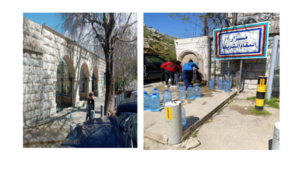
Maqām Al Sharīf, entrance, Photo: Rima Barakat April 2024.
This source of water is similar to the ablution fountain used for wudū3 at the entrance or in the courtyard of a mosque. Here, however, for the Druze, one uses natural spring water to fill plastic bottles with fresh water that the pilgrims use during their feast in the maqām premises as some visitors come from far places to pay their respects and need to drink, eat, and rest before going back home.
Down the flight of twelve steps of stairs divided into three parts, one arrives at the courtyard surrounded by porticos on three sides, similar to the archetypical architecture of the mosque, but without topping domes. Steps heralding the entrance to a maqām demarcate the sacred from the common, profane area. The porticos on each of the three sides are made of pointed “Persian” archways resting on two Doric columns, set on blocks. Arches are used here, instead of simple columns for aesthetics and assimilation to Islam4.
To the west, after ascending a few steps to demarcate again the courtyard from the sacred area, one enters the marble tomb area housing the remains of the venerated nabi. A five-star, colored Druze emblem tops the arch signifying the entrance. A plaque at the entrance dictates the rules in the maqām such as removing shoes, covering hair, and abstinence from food, drink, and play, see picture below5.
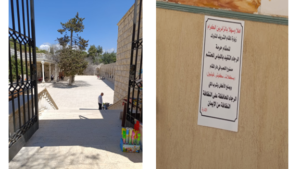
Maqām Al Sharīf, gateway and rules, Photo: Rima Barakat April 2024.
The tomb is enclosed within a cage at the lower end. Otherwise, it is open to the pilgrims from above, as believers are usually invited to touch and kiss the marble cenotaph. This is similar to Muslim mausolea, which are encased. The marble darīḥ or cenotaph of the Druze saint is elevated on two levels to increase the height and to invite people to bend over, kneel and touch their heads while praying and making vows. This practice is also similar to Christian praying rituals in pilgrimage sites. 6The darīḥ is covered with sheets embroidered with the Druze khams hdūd -the emblem of the Druze referring to the five disciples who spread the Druze faith-with these sheets covered by another arabesque brown and white sheet.
The sanctuary area contains the cenotaph of the saint, a treasury to insert money and candles to light in prayer. Pilgrims are expected to be silent, recount prayers, and be respectful of the premise. Pilgrims touch, kiss, take blessings with their forehead, and rub the body of their sick loved ones with sanctity from the saint’s tomb. The tomb is topped by a dome on the inside, but there are no decorations on the dome, as in that of a mosque. Decorations inside a dome in a mosque, however, remind one of heaven. Perhaps, the reason for the simplicity of Druze domes from the inside is that Druze do not believe in heaven7. For Druze, domes are a visual marker for pilgrims who historically come from distant places into an alien, new area, as well as a functional designation of the sanctity of the place. Based on old photos, it is clear there were carpets on the walls with animals, and other objects. However, there were some hangings on the walls with stories from the life of Jesus Christ and Saint George with the dragon8. Strangely, the Druze venerate neither Christ nor Saint George. So probably, the interest in Christ is because the Druze believe that Nabi Bahā’ Al dīn is the incarnation of Saint Luke, one of the four apostles of Jesus Christ9. In addition, the walls are covered with embroidered kuranic sūras offered by the Druze religious women known as shaykhas or by some pious visitor.
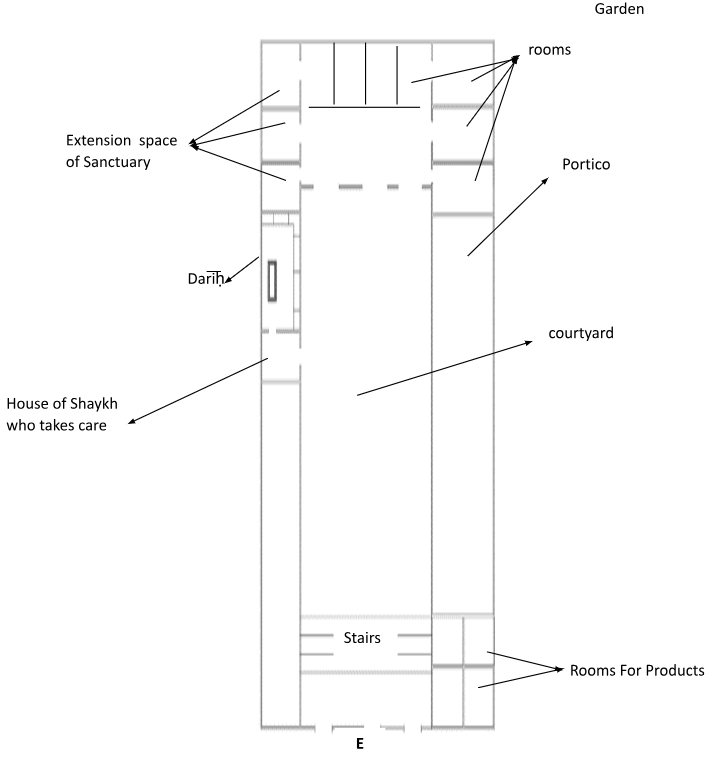
Plan of Maqām al Sharīf, Rima Barakat, April 2024
On the side of the sanctuary is a safe box, where the believers leave money, in the hope that it will be given to Druze orphans. After donating money, they receive a candle which they light, pray for a baraka or spiritual power, make vows or nizirs, in hope that lighting a candle would remind the saint of the miracle they need. Rubbing one’s head against the tomb of Nabi Bahā’ Al dīn and massaging the children’s bodies with sacred oil available at the site is professed to heal against sicknesses and to intercede in all matters of hardship.
As the Druze practice religious camouflageism, the architecture and rituals followed in this Druze mausolea follow some of those of Muslim and Christian sanctuaries. For example, Druze follow the lighting of candles, kneeling in front of the darīḥ, and spreading oil available near the cenotaph on believers’ bodies. All these practices were previously Christian traditions too.
This Druze shrine is adjacent to a natural spring of water, considered blessed according to both religions. However, comparatively, though in Islam water was used for ablutions before prayer, in Druze and Christianity, water was used to drink with a meal. In parallel with Islamic shrines, Druze darīḥs are encased, in order to prevent sullying and defaming, and the pilgrims are expected to kiss the tomb, caress, touch and rub one’s hands on it10. In this maqam, the darih, the cenotaph, is set in the middle, and pilgrims move around several times in an act of circumambulation. Circumambulation or tawwāf is originally the central ritual in the Islamic pilgrimage that involves circling the Kaaba during Hajj. This practice has extended to rituals among the Druze but is less commonly practiced by the Druze than by Muslims.11 Additionally, Druze and Muslims are both expected to remove their shoes and cover their heads and exposed bodies upon entering into a religious sanctuary.
Moreover, the architecture of some of the Druze shrines contains a courtyard with covered porticos on two or three sides. The dome is especially important in all Druze mausolea, but in Druze mausolea, it is always white. Although Muslim domes represent heavenly sacredness from the inside, for the Druze, they are a physical, revered marker for pilgrims. Arches are also heavily used in Druze mausolea, and architects claim they are used for aesthetic reasons, durability and assimilation to Islam. Stairs are commonly found in Druze mausolea to separate the profane from the sacred area. This practice is also commonly found in Muslim shrines. Finally, inscriptions incised into metals, stone, and velvet is a common practice, and various sūras from the Qur’an are commonly copied onto these materials in Druze maqams.
Druze follow religious practices in devotion similar to that of Christians and Muslims in many ways. Other particularities stand out for the Druze specifically. Since Druze bifurcates from Islam, it follows significant architectural practices to that of their Muslim counterparts. However, as one observes closely, the Druze are unique in the practices they observe, and though they strongly identify with Islam in some rituals and architectural motifs, they differ in many other specific characteristics.
Footnotes:
- Maqam is a sacred site associated with a saint or holy figure. It is either the shrine where the holy figure was buried or the place the saint touched or slept in before going somewhere else.
- Nabi Bahā’ Al Dīn is one of the most important early leaders and theologians of the Druze religion in the 11th century who wrote a part of the Druze sacred collection of books.
- https://www.bbc.co.uk/religion/galleries/wudhu/
- Rima Barakat, Personal Interview with Samer Ghannam, April 2, 2024.
- Booklet, Maqām alNabi Shamlīkh, Aley, 1967.
- Nour Farra Haddad, “Shared Rituals through Ziyārāt in Lebanon: A Typology of Christian and Muslim Practices: Case studies on Islam,” in Performing Religion: Actors, Contexts, and Texts edited by Ines Weinrich .(Beirut:Orient Institut, 2017). 39-40.
- Sami Makarem, The Druze Faith (Delmar, NY: Caravan Books, 1974), 6.
- Nour Farra Haddad, “Devotions to a Druze Saint: From Philosopher to Founder Saint of the Community”, 163.
- Nour Farra Haddad, “Devotions to a Druze Saint: From Philosopher to Founder Saint of the Community”, 164
- Sami Makarem, Maslak altawḥīd, alkhalāwāt fī lubnān, (Beirut, 2008) 7.
- Nour Farra Haddad, “Shared Rituals through Ziyārāt in Lebanon: A Typology of Christian and Muslim Practices: Case studies on Islam,” 40.
Reference:
Barakat, Rima Personal Interview with Samer Ghannam, April 2, 2024.
Booklet, Maqām alNabi Shamlīkh, Aley, 1967.
Haddad, Nour Farra, “Devotions to a Druze Saint: From Philosopher to Founder Saint of the Community” in Druze Reincarnation Narratives, edited by Gebhard Fartacek, 145-160. Bern: Lang Publishers, 2021.
Haddad, Nour Farra, “Shared Rituals through Ziyārāt in Lebanon: A Typology of Christian and Muslim Practices: Case studies on Islam,” in Performing Religion: Actors, Contexts, and Texts edited by Ines Weinrich, 37-52 Beirut: Orient Institut, 2017.
Makarem, Sami, The Druze Faith: Beirut: Caravan Press, 2016.
Makarem, Sami, Maslak altawḥīd, alkhalāwāt fī lubnān: Beirut, 2008.
(The views expressed in this article are the author’s own. Content can be used with due credit to the author and to ‘Zariya: Women’s Alliance for Dignity and Equality’)
About the Author

The Nigerian-born Rima Barakat began her career after being mesmerized by the Museum of Modern Art (MoMA) and the Metropolitan Museum of Art (The Met) in New York in 2006. That same year, she joined the Art History program at the American University of Beirut (AUB) and graduated in 2008 with distinction. During her studies at AUB, her research focused on overlooked and misinterpreted women artists, the psychoanalysis of art, and the study of Islamic art objects. Shortly after graduating, Barakat published two pieces: “Abstract Sculpture Cropping up in Beirut’s Public Spaces,” published in Al Jadid, Vol. 15, no. 60 (2009), and a review in The Daily Star (2008) of Jamil Molaeb’s exhibition titled “Jamil Molaeb and the Importance of Working with Nature.” She remains actively engaged in reviewing and assessing art exhibitions. In 2025, she earned her Master’s degree in Islamic Art History from the Lebanese American University (LAU). Her current interests include contemporary Middle Eastern women artists, as well as Druze art and artists.