Rogan Art: A Living Testament to Indo-Persian Muslim Heritage
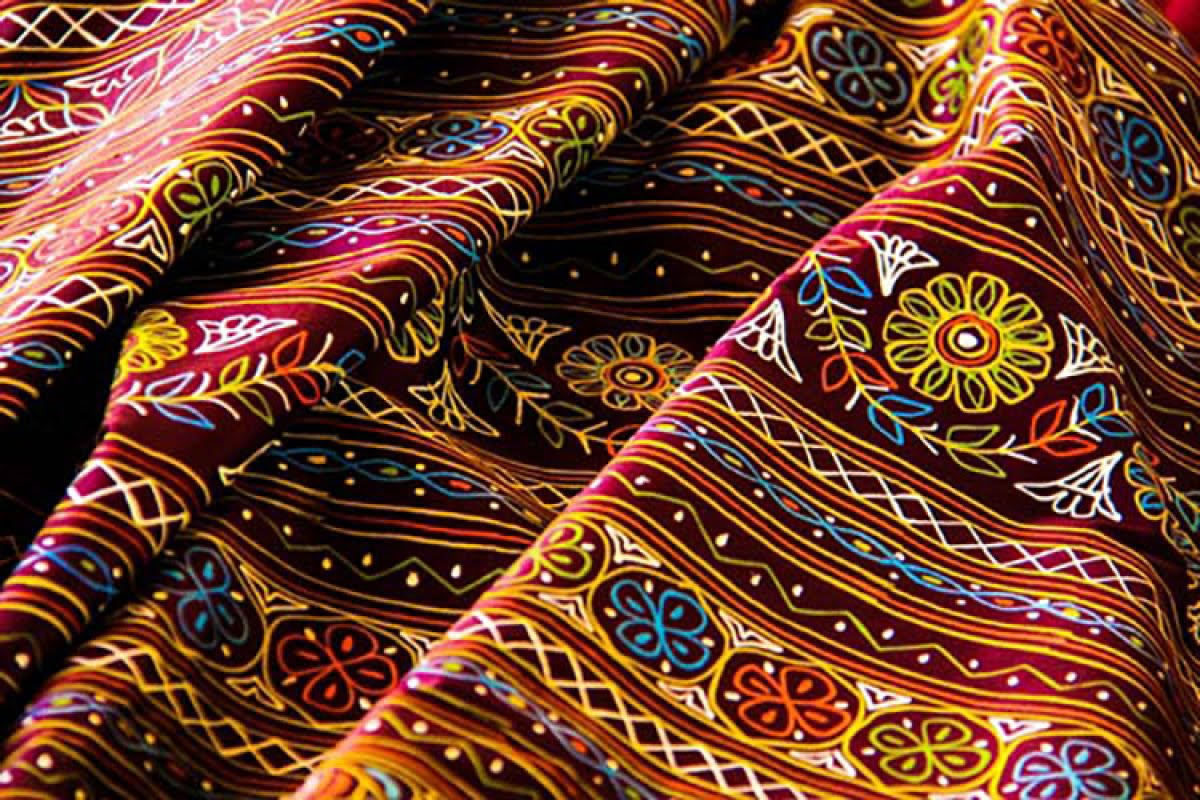
India’s textile heritage is among one of the oldest and most diverse in the world, shaped over centuries by royal patronage, folk traditions, and the creative genius of artisans from all walks of life. (Image-The intricate patterns and colours of Rogan Art. Source- Indiafellow, 2015). Among the many remarkable crafts that have evolved across the subcontinent, Rogan art stands out as one of the rare and captivating forms of textile painting, celebrated for its intricate freehand designs and vibrant visual language.
The word ‘Rogan’ stands for oil in persian and this very etymology carries within it the entire story of this extraordinary craft. Rogan art is a method of textile painting in which a thick paste made from castor oil is boiled for many hours and blended with mineral pigments, then applied freehand to fabric using an iron stylus like object called a kalam. The result of this is a shimmering raised surface of colour that resembles embroidery but is in fact painting.
Scholars believe the craft originated in Persia noting that its aesthetic elements like flowing floral scrolls, geometric symmetry and the iconic tree of life motifs reflect strong middle eastern influence.1 Rogan painting is documented to have once existed in Peshawar, Lahore and Pattan where a similar oil-based textile tradition was practised by muslim communities2. As these communities migrated and dispersed over the years, the craft crossed the Sindh region into the Kutch district of Gujarat India, carried by the Khatris who are a community of Muslim artisans with roots in Sindh, Pakistan3.
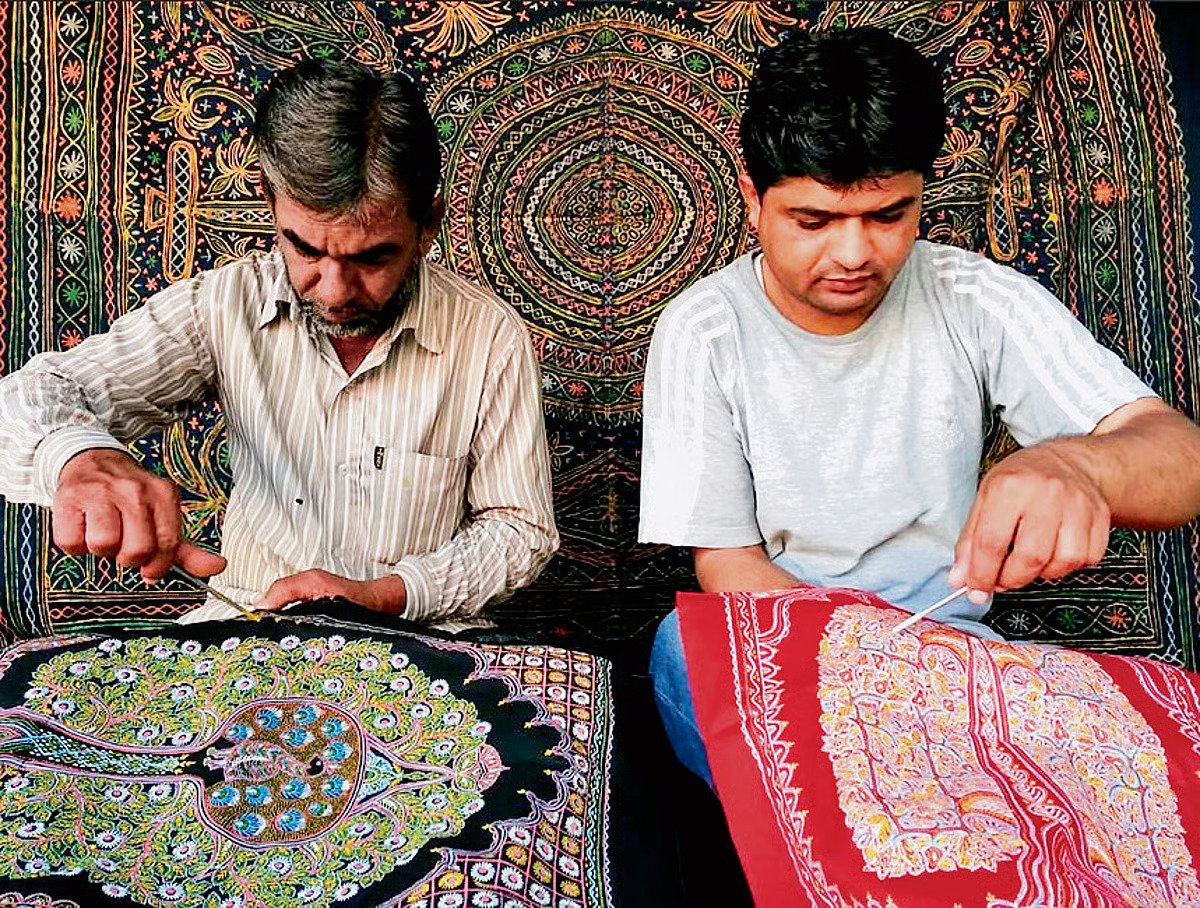
Abdulgafur and his younger brother Sumar Daud Khatri making ‘tree of life’. Source: The New Indian Express, 20264
The custodians of a living tradition
The Khatri community migrated from Sindh to Gujarat, an Indian state in the western region, according to some records, in the beginning of around 1540, initially as silk weavers. Over time, they became master craftspeople across multiple textile disciplines such as bandhani (a type of tie and dye technique), ajrakh (a type of hand block printing) block printing and rogan painting.5 They are a small muslim community within Gujarat, and their craftsmanship has long been intertwined with their cultural and religious identity.
Today, Rogan art survives almost entirely because of a few families. What was once practised by four or five families in the region has shrunk due to decades of economic hardship and declining demand to this sole lineage6. Abdul Gafur Daud Khatri, the family’s senior master craftsman was awarded the National Award for Master Craftsman in 1997 by the government of India, and numerous members of his family hold national and state awards among them7. For over eight generations, the Khatri family of Nirona village in Gujarat has single-handedly kept this art alive.
The art itself
The making of Rogan paste is a process of alchemical patience. Castor oil grown locally in Nirona in Gujarat is boiled for up to fourteen hours in aluminum vessels, usually outside the village away from homes because the heated oil is highly flammable and produces powerful odour8. From three kilograms of oil, barely half a kilogram of thick resin is produced. This resin is stored in water to prevent it from drying and can be kept for up to two months before use9.
While painting, the craftsman clips the fabric to his clothing to keep it very tight. The artist warms a lump of coloured Rogan paste in their left palm, softening it with body heat, then draws out fine threads using the iron kalam, applying them directly to the fabric with no preliminary sketch or outline. No stencils or tracing. In fact it’s purely the artist’s trained memory and steady hand10. One of the art’s most celebrated techniques involves painting only one half of the design on the fabric, then folding it precisely along the central axis and pressing gently so the painted side transfers a perfect mirror image onto the other half. The process is something very unique and interesting.
The tree of life and the language of motifs
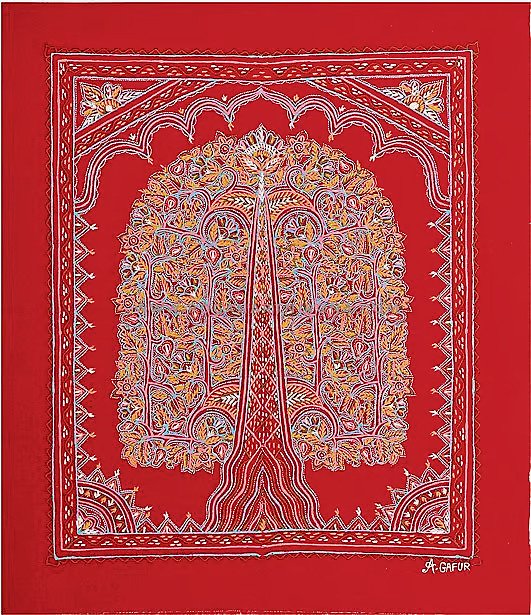
The tree of life painting Source: (The New Indian Express, 2026)11
Rogan art’s visual vocabulary is rich and versatile. Traditional motifs include geometric patterns, parrots (popat), vesur (wavy lines), trikhani (three dots), elephants, flowering vines and calligraphic elements. Floral borders known as panfarei (leaf/flower) and phool vel (floral vine)carry echoes of intricate mosque tilework and Persian garden imagery12.
The most iconic of all Rogan designs is the Tree of life which is a symbol that appears across Islamic art, sufi mysticism, and Hindu tribal traditions alike. It’s a motif that speaks to the shared spiritual landscapes from which this craft emerged. This design is also found on medieval mosque walls and stepwells across the region.
Conclusion
For much of the twentieth century, Rogan art teetered on the edge of extinction. Industrial crafts undercut the crafts market, younger generations left the village in search of more reliable livelihoods. By 1983, only Abdul Gafur Khatri’s father remained as a practicing artist13. The family’s persistence has since turned that near-disapperance into a cautious revival. Today nine members of the Khatri family practise and sustain the craft. Abdul Gafyr has trained over 300 girls from different Kutchi tribes, many of whom now work as Rogan artists.
During the pandemic when physical craft fairs and workshops were unable to take place, the Khatris adapted by shifting to digital platforms such as live streaming their process on Instagram , Facebook and Youtube in collaboration with organisations like Paramparik Karigar, Mumbai.
Footnotes:
- A Glorious journey of Roghan painting from Kutch. (2014). https://www.isca.me/FAMILY_SCI/Archive/v2/i1/1.ISCA-RJFCCS-2013-026.php
- Ibid., 1.
- Sharma, M. V., & Sharma, D. r S. (2022). ROGAN ART OF KUTCH GUJARAT. In International Journal of Creative Research Thoughts (IJCRT) (Vol. 10, Issue 12, pp. 256–258) [Journal-article].https://ijcrt.org/papers/IJCRT2212597.pdf
- Mohd Shehwaaz Khan. (2026, February 1). Kutch kutch hota hai. The New Indian Express. https://www.newindianexpress.com/magazine/2026/Feb/01/kutch-kutch-hota-hai
- Batham and Arora, “A Glorious Journey,” 2.
- Dr. Shruti Tiwari and Aastha Joshi, “ The remaining essence of Rogan Art: In context of innovative business practises of craft heritage,” International journal of creative research thoughts (IJCRT) 9, no. 8 (August 2021): d536.
- Sharma and Sharma, “Rogan Art of Kutch Gujarat,” f258.
- Batham and Arora, “A Glorious Journey,” 2-3.
- Sharma and Sharma, “Rogan Art of Kutch Gujarat,” f259.
- Tiwari and Joshi, “The remaining essence of Rogan Art,” d538.
- Mohd Shehwaaz Khan. (2026, February 1). Kutch kutch hota hai. The New Indian Express.https://www.newindianexpress.com/magazine/2026/Feb/01/kutch-kutch-hota-hai
- Tiwari and Joshi, “The remaining essence of Rogan Art,” d538-d539.
- Tiwari and Joshi, “The remaining essence of Rogan Art,” d539.
References
- A Glorious journey of Roghan painting from Kutch. (2014). https://www.isca.me/FAMILY_SCI/Archive/v2/i1/1.ISCA-RJFCCS-2013-026.php
- Sharma, M. V., & Sharma, D. r S. (2022). ROGAN ART OF KUTCH GUJARAT. In International Journal of Creative Research Thoughts (IJCRT) (Vol. 10, Issue 12, pp. 256–258) [Journal-article]. https://ijcrt.org/papers/IJCRT2212597.pdf
- Desk, I. A. (2025, September 18). Ashish Kansara: Reviving and Preserving the Ancient Rogan Art – Rogan Art. Nirona Rogan Art Madhapar. https://nirona.in/ashish-kansara-reviving-and-preserving-the-ancient-rogan-art/
- Tiwari, S., & Joshi, A. (2021). The Remaining Essence of Rogan Art: In context of Innovative Business Practices of craft Heritage. International Journal of Creative Research Thoughts (IJCRT), 9(8), 536–538. https://www.ijcrt.org
- Shome, P. (2023, December 21). Obsolete: Why Gujarat’s Rogan Art is dying? – Abirpothi. Abirpothi. https://www.abirpothi.com/obsolete-why-gujarats-rogan-art-is-dying/
(The views expressed in this article are the author’s own. Content can be used with due credit to the author and to ‘Zariya: Women’s Alliance for Dignity and Equality’)
About the Author
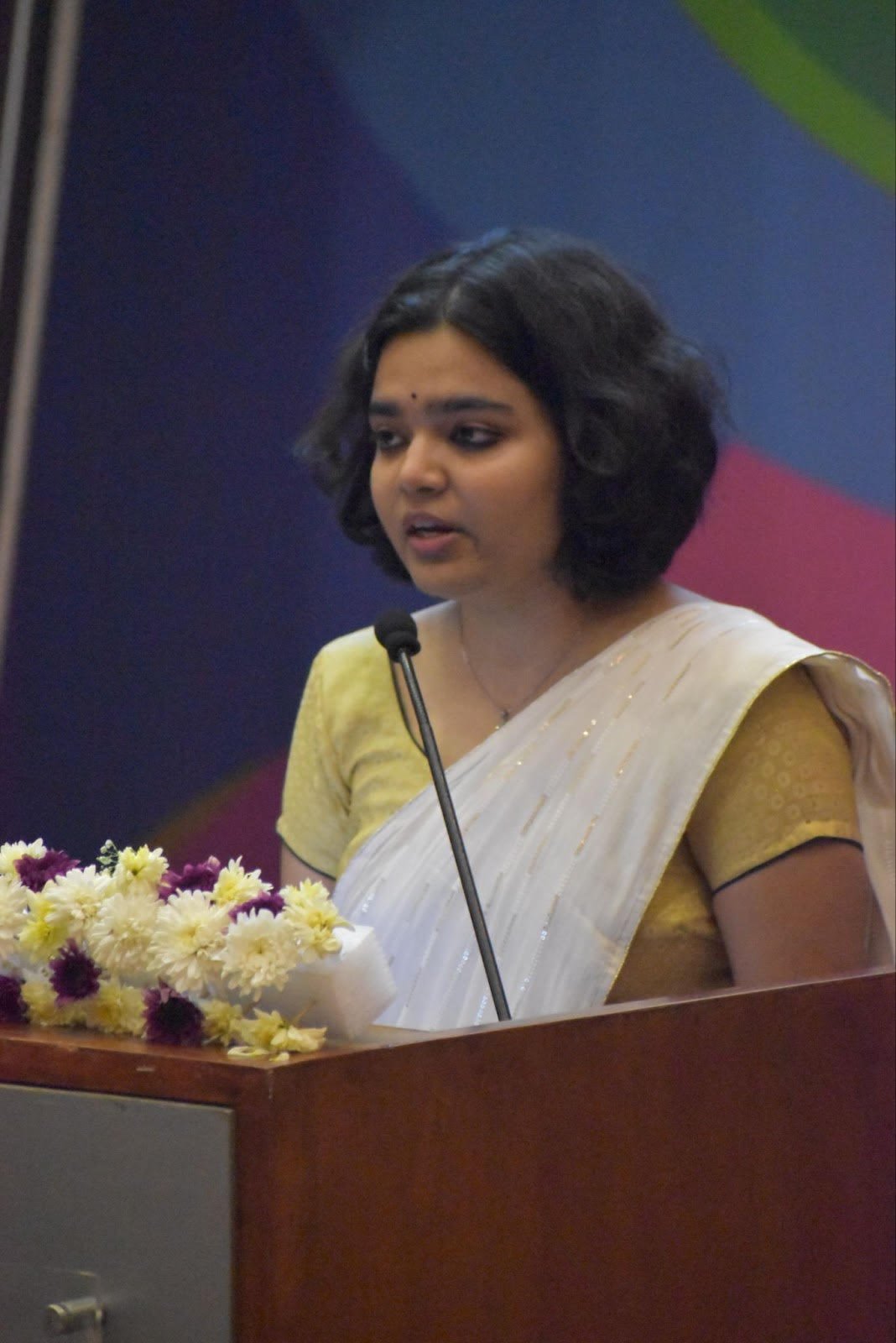
Rajika Kanungo is a final year Masters student specialising in women centered social work at the Tata Institute of Social Sciences, Mumbai. Her areas of interest include researching on various social and environmental themes including intersectionality, caste, gender, tribal discourse and ecofeminism.