A Conversation with Karim Jabbari : World Renowned Tunisian Calligraphy and Light Artist Engaging Arabic Script as a Luminous Medium and Cultural Memory.
Karim Jabbari is a distinguished Tunisian artist known for his innovative fusion of traditional Islamic calligraphy with contemporary art forms. His work is a testament to the enduring relevance and adaptability of calligraphy, which he regards as a living language capable of speaking to modern audiences. He was named among the Top 30 Public Artists by the International Award for Public Art (IAPA). His monumental work including North Africa’s longest mural in Kasserine and the illuminated minaret in Sousse demonstrate his commitment to situating Arabic calligraphy within public space.
1. You’ve described your work as being rooted in Islamic artistic traditions. How do those traditions shape your approach and creative process?
Islamic artistic traditions shape my work at its very core. My creative process is essentially an attempt to build a bridge between the ancient art of calligraphy sacred in its origin and essence and contemporary artistic languages, materials, and technologies. I see my role as translating that inherited spiritual and aesthetic legacy into forms that can speak meaningfully within the present moment.
My sources of inspiration are rooted first in lived experience, the memories of childhood, the experiences that shape me, and the ideas and texts that I encounter. Yet above all, my practice draws from the Qur’an, the Sunna, and the stories of the Salaf and the beloved Companions. These spiritual and historical references anchor my work, ensuring that even as I experiment with new media or approaches, the art remains grounded in its sacred lineage
2. What initially led you to work with Arabic calligraphy, and what aspects of it continue to inspire your practice today?
My story with Arabic calligraphy goes back to my childhood, when I was about eleven years old. If I were to describe what I do today, I would say that I am trying to keep alive the very thing that once kept me alive. I am trying to give back to what gave meaning and definition to my childhood, and to highlight an art form that shaped a profound part of my life, especially in moments when I felt lonely, sad, and disconnected.
At that time, my family was living through very difficult circumstances. My father was persecuted for his political opinions and eventually sentenced to thirteen years in prison. As a family, we suffered deeply from this. We lived in a state of isolation almost like being under siege or house arrest, unable to move freely, and socially avoided by others who feared association with us. When people saw us in the street, they would often cross to the other side to avoid being connected to our situation.
During this period, I found refuge in the old books and manuscripts my father kept at home — handwritten volumes that were three or four hundred years old. I was fascinated and mesmerised by the fact that a human being could create something so vast and beautiful by hand. I would look at them secretly, touch them when I was not supposed to, and feel an intense curiosity and wonder. Those manuscripts drew me into writing itself. I began to practice, to explore, and to discover a deep joy in the act of writing. Inspiration surrounded me: storefront signs, writing on walls, newspapers. I became obsessed with the visual form of letters and script.
At the same time, I was studying at an elite boarding school two hours away from my hometown. There, no one knew about my family’s situation or our isolation. But what they did know was my ability to write. That ability brought people toward me; it gave me friends and a sense of belonging. I became known among my peers as ‘the calligraphy artist’. In many ways, I felt that I existed through writing that calligraphy gave identity and presence to my childhood.
Now, at the age of forty-seven, after more than twenty years devoted to Arabic calligraphy, I look back with gratitude. I am thankful that I fell in love with those manuscripts and that art at such a young age, because they gave meaning to my life then, and they continue to give meaning to my life today.
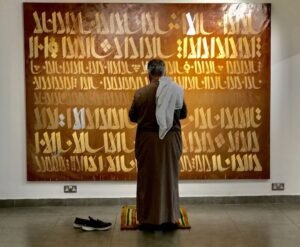
Karim Jabbari, calligraphic panel installation
3. Your work brings together historic scripts such as Maghrebi and Kufi with contemporary methods like light-based and urban art. How do you navigate the relationship between experimentation and tradition?
In many ways, it all goes back to the manuscripts I used to look at as a child. They were written in Maghrebi script, a form I truly fell in love with. I am drawn to its curves and the freedom it offers. Unlike more rigid calligraphic styles, Maghrebi is fluid and close to natural handwriting. It is not restrictive or overly prescriptive; it invites play and exploration. There is no pressure in learning or using it, and that openness allowed me to connect deeply and learn intuitively, especially in relation to the visual memories I carried from childhood.
I feel a similar connection to early Kufi. To me, it is an ancient and essential form of writing the script in which the companions wrote letters on behalf of the Prophet to rulers and leaders. Both Maghrebi and early Kufi embody what I see as the pure essence of writing: they are not overly curated or driven by perfectionism, but instead offer a generous freedom to the writer. That quality helped me develop quickly and later shaped how I transmit calligraphy through workshops, masterclasses, and live performances. People respond to it because it feels direct, soulful, and accessible, a form that invites participation.
Working with these scripts eventually led me toward experimentation with light. Around 2008–2009, I began exploring light painting, using long-exposure photography to draw calligraphic forms in space. Light painting is basically playing with a light using long exposure photography. I was interested in training those spontaneous, “wild” lines into legible writing while allowing them to retain their energy. I’m always looking for new mediums, always looking for ways to incorporate modern day technology and modern day mediums with the ancient form.
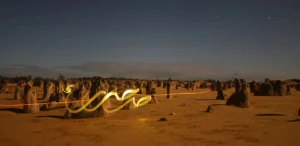
4. By placing calligraphic work in public and urban settings, your art reaches audiences beyond traditional art spaces. How do you think this visibility influences community engagement and perceptions of Islamic art?
Light calligraphy, I always say, allows me to write in places I’m not normally allowed to. As a calligraphy artist with a background in street art, that is very important to me. The essence of street art is to democratise art to bring it into the public realm so people can encounter it in their daily lives, without needing to visit museums or galleries. It becomes a voice that exists in public space. That voice was very tempting to me. I loved the idea of having my work out there on murals, in hidden spots in the city, or as installations. Working in public space allowed me to reach a much wider and international audience.
In my murals, I work with an old Kufi style, using a visual matrix built from two letters we call ḥurūf al-taʿrīfthe letters of definition: alif and lām. In Arabic, when you place these letters before a word, it moves from being unknown to being known. For example, if I say madina, it could be any city; but if I say al-madina, everyone knows which city I mean. Using these two letters, I create a visual matrix. From a distance, it appears as a timeless artwork almost without language, something that speaks first to the heart and the soul before the eyes recognise the script.
Within this matrix, I usually hide poems or quotes. I do not use Qur’an or Hadith in public space, out of respect. Instead, I work with texts that inspire me, quotes from Imam Shafi‘i, poems by Abu al-Qasim al-Shabbi, or even translations of contemporary poets and hip-hop artists such as Yasiin Bey, Talib Kweli, or the group DAM. In this way, I use Arabic letters to show the beauty of calligraphy in the public realm and to connect with a wider audience.
After I place a mural in a cultural or urban space, the rest is out of my control. It becomes a piece of me left there. The impact spreads like a ripple effect. People pass by it every day, form connections, and sometimes years later I still receive messages from those who encountered a work long ago. That is very beautiful to me, and it aligns with the mission I have set for myself: to take Arabic calligraphy into public life and across the world.
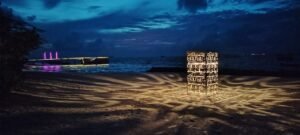
Karim Jabbari, illuminated Arabic calligraphy installation, Hatta, United Arab Emirates
5. As artistic tools and technologies continue to evolve, how do you imagine the role of Islamic calligraphy changing in the years ahead?
I see myself as a fierce defender of preserving the essence of Arabic calligraphy, keeping the traditions alive and the art form rooted in its original spirit. I am for experimentation, but I am against fully diving into things like Artificial Intelligence (AI) in a way that disconnects the practice from its human and organic nature. My mission has always been to act as a bridge: to help the art evolve while remaining grounded in its essence.
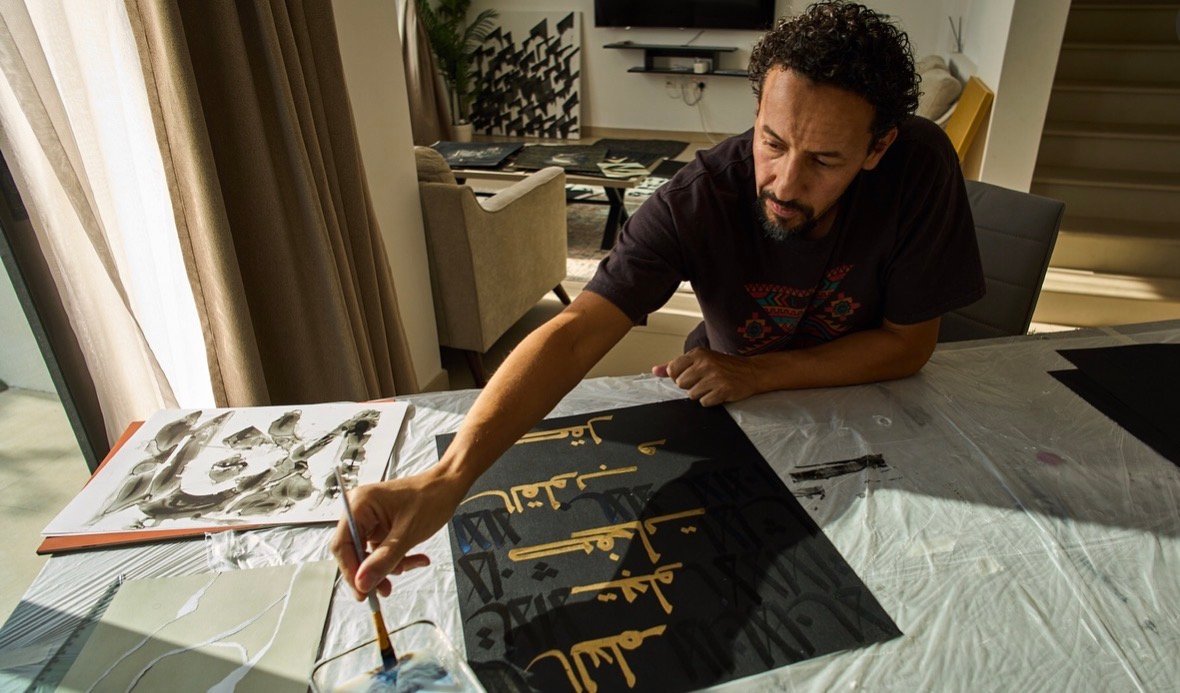
For example, in the way I paint, I use brushes and approach a mural the same way I would approach paper. I work with this ancient form of writing, with its imperfections, its beautiful curves and lines, and I try to bring that closeness and authenticity to the viewer. I also lead masterclasses and workshops, encouraging people to keep writing by hand, because we are gradually losing the art of writing to tablets, digital tools, and now AI is exerting a pervasive influence over all aspects of life.
Due to this, I feel my mission today is more important than ever: to encourage people to reconnect with what is organic and natural, something that requires effort, discipline, and human touch as opposed to what is purely digital and effortless. I believe these efforts will help Islamic and Arabic calligraphy continue to evolve in the years ahead while remaining fully rooted in its origins.
6. As part of Muslim History Month, what would you like audiences particularly those new to Islamic visual culture to understand about calligraphy and its significance?
For me, calligraphy is the anchor of our history. It is the way our ancestors transmitted knowledge into written form, and it is the link that keeps us grounded. If we understand it, stay faithful to it, and keep our connection with it alive, we are essentially maintaining a living connection with our own history. If we stop writing, we have nothing to transmit. And if we lose interest in this art form, we risk breaking a chain of knowledge transmission that has existed since our father Adam. That is a truly dangerous slope.
Today, we are moving quickly toward typing and digital devices. Writing is disappearing from daily life, even sketchbooks are becoming digital. This is something we need to be aware of. By spreading awareness about calligraphy and its significance, I hope that even a small number of people will reconnect with it and take action. From there, the impact can expand widely.
I see this happening already through my work in different countries. When people encounter Arabic calligraphy in public space, I see curiosity in their eyes. They want to know more. They become hungry for knowledge and begin to look toward the deeper sources of history and identity. For me, that is one of the most beautiful aspects of what I do.
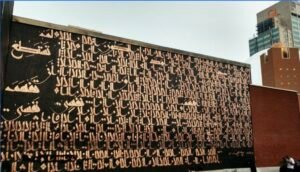
7. Any other points that you may wish to highlight on Islamic art and its significance
I would like to highlight something very personal. I feel that today I am living the dream of the child I once was , a child who used to sit alone under a tree, looking toward the horizon and missing his family, searching for something that could connect him to them. In that loneliness, I built a kind of inner world, a safe bubble where I could be myself and feel whole. I used to close my eyes and dream. That dream stayed alive within me, and it is still alive in my work today.
Later in life, I chose the extremely challenging path of becoming an artist. It was a big risk, a leap of faith that required courage. I am deeply grateful that I was brave enough to believe in that childhood dream: the simple act of closing my eyes and imagining a beautiful world. Today, I still close my eyes and I write calligraphy in space. The works I create travel across borders, nations, and cultures, inspiring people I may never meet. That, in itself, is something very beautiful.
What I would like to share is this: I hope people trust in Allah and trust in their ability to pursue what they truly love, with passion and sincerity. As an ummah, we need the full potential of every individual. We already have many engineers and doctors; we also need artists, creators, and people who follow their calling, people whose work and presence can have a different kind of impact. That is something I wanted to express.
(The views expressed in this article are the interviewee’s own. Content can be used with due credit to ‘Zariya: Women’s Alliance for Dignity and Equality’)