Mathematics of the Sacred: Quranic Resonances in Islamic Geometric Art
Art: Sana Khan
Islamic art has a history that dates to the early days of Islam. One of the first forms of Islamic art was calligraphy, which was used to write the Qur’an. The earliest form of Islamic calligraphy was written in the Hijazi script1, which was the script used to write the Qur’an during the time of the Prophet Muhammad (PBUH). Another form of Islamic art that also emerged at the time was the use of geometric designs. Islamic geometric designs are based on simple geometric shapes, such as circles or squares but are highly intricate and symmetrical. Some scholars, including Oleg Grabar (1973) have pointed out that the use of geometry in Islamic art is thought to have been influenced by the Arab love of mathematics and science.
This article attempts to understand the symbolism in Islamic geometric art often referred to as sacred geometry in relation to the Qur’an. It examines how Qur’anic teachings concerning unity, order, beauty, and creation are reflected in geometric patterns.
Historical Context: The Qur’anic Influence on Islamic Art
There has been a profound impact of the Qur’an on Islamic art. It has shaped artistic expressions, nurtured a unique aesthetic language, and served as a vehicle for spiritual devotion and reflection. The Qur’an not only holds religious significance but also serves as a source of artistic inspiration, guiding artists in their pursuit of creating exceptional art, expressing devotion, and connecting with the divine.
One of the most crucial factors that influenced the development of Islamic art was the Islamic belief in the importance of visual art as a means of expressing religious and spiritual ideas while avoiding idolatry. Since Islam does not endorse the depiction of human and animal figures, Islamic artists focused on abstract designs and patterns relating them to faith.
David Talbot Rice (1965) observed that Islamic art became associated with a distinct architectural and ornamental system relatively early in the era of the Hijra2, and that it is characterized by coherence and unity. Although later scholars have noted regional variations in materials and techniques, the underlying vocabulary of geometry, calligraphy, and arabesque3 demonstrates a shared conceptual foundation rooted in the Qur’an.
Islamic art from different parts of the world and from different periods of time often shares a common style and vocabulary of motifs. This coherence is partly due to the universality of Islam and the central role of the Qur’an as a unifying source. Despite regional diversity, the emphasis on order, proportion, and abstraction remained constant.
Calligraphy and the Geometry of the Written Word
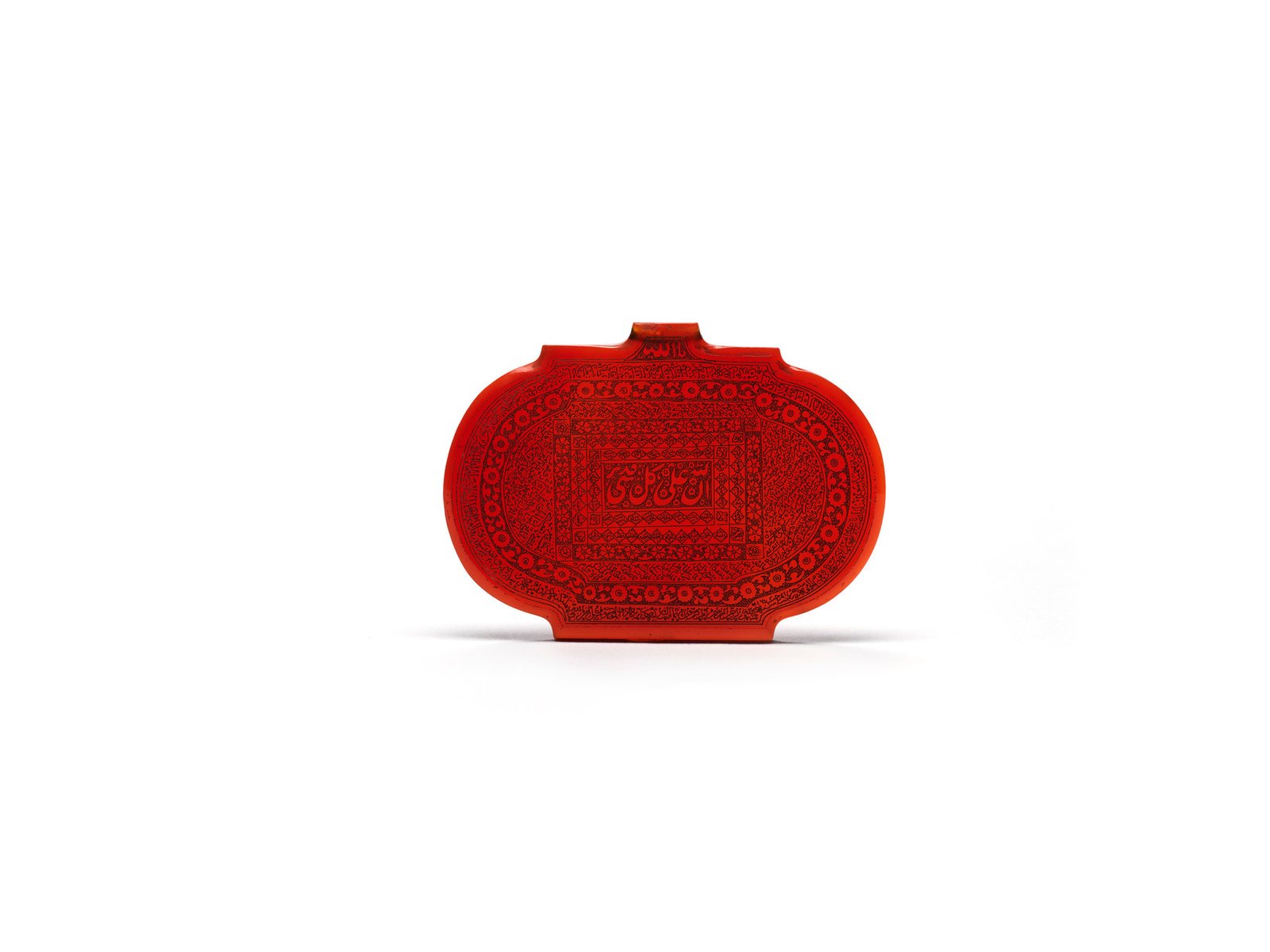
One of the most prominent manifestations of the Qur’an’s influence on Islamic art is calligraphy. From the early centuries of Islamic civilization, calligraphy became a central form of artistic expression, characterized by the intricate and ornamental rendering of Qur’anic verses. The emphasis on calligraphy stemmed from reverence for the written word of the Qur’an and the belief that beautiful penmanship reflected spiritual devotion.
As Daud Sutton (2007) explains, the Qur’an literally means “recitation”, for initially the Qur’an was memorized by heart. Soon, however, it became necessary to record it in written form, and the Arabic script became the focus of generations of devoted scribes striving to develop the most suitable hands for the scripture (2007: 12). Sutton discusses how the fundamental starting points of geometry underpin calligraphic form: each letter is proportioned in relation to the circle, its diameter, and the nuqta marked as a rhombic dot with the reed pen. The letter alif, traced as an elegant vertical stroke, is proportioned according to specific systems of spaced nuqāt (Sutton 2007: 12).
Thus, geometry is embedded within the very structure of the script used to transmit revelation. The circle and the point function as metaphors for unity and origin. The visual harmony of calligraphy reflects the inner harmony of divine speech. Geometry and revelation are therefore inseparable at the foundational level of form.
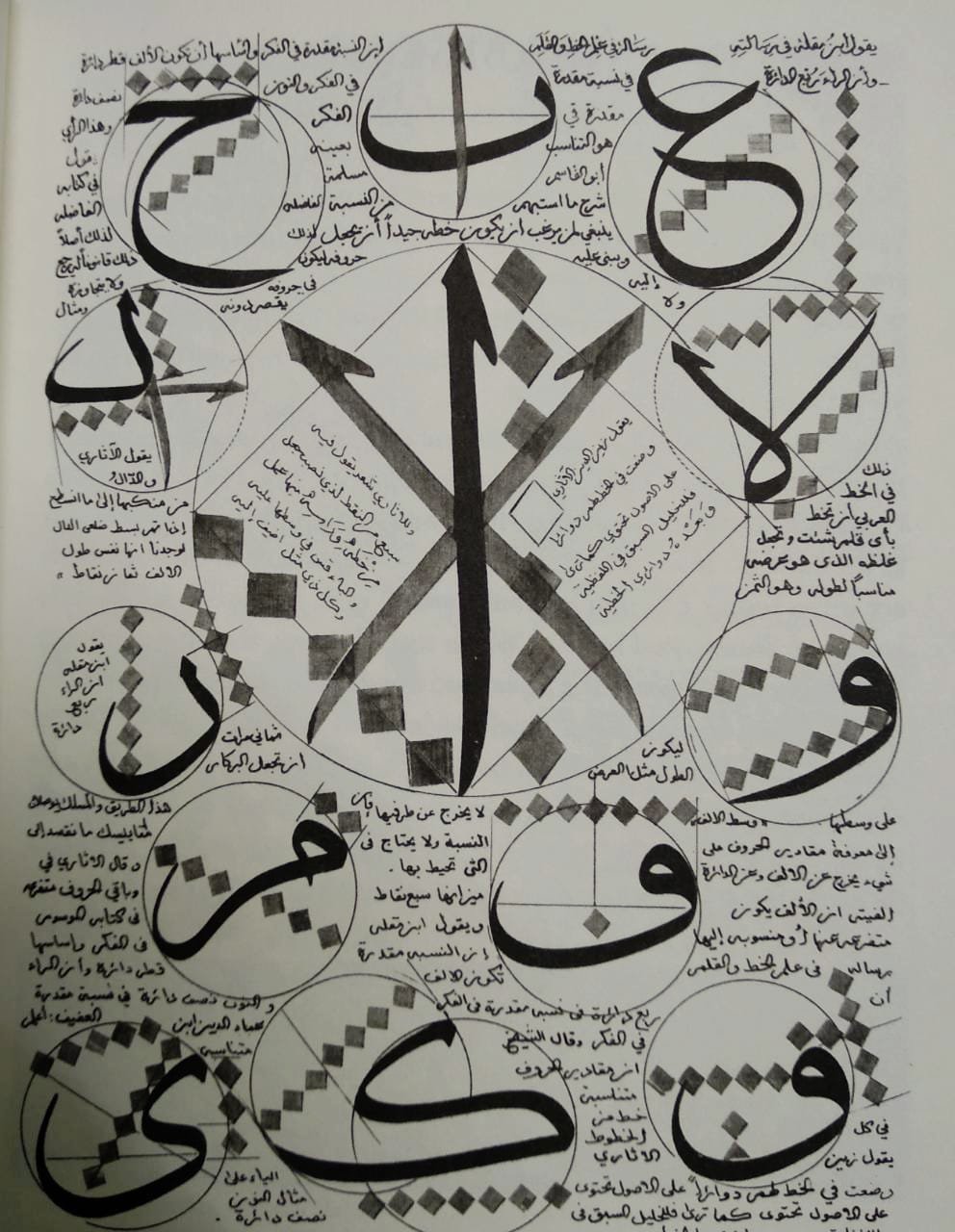
Image From Sutton (2007)
Geometry and Tawhid: Unity and Multiplicity
Geometry holds a significant place in Islamic art and is deeply influenced by Qur’anic principles. Islamic geometric patterns, characterized by interlacing lines, polygons, and star shapes, adorn architectural structures, manuscripts, textiles, and decorative objects. Their use is often associated with the concept of tawhid—the oneness of God.
The Qur’an repeatedly emphasizes the unity and coherence of creation. Verses such as “He has made the seven heavens in perfect order” (Qur’an 65:12) and “Allah’s craftsmanship is evident as He arranges everything in perfect harmony” (Qur’an 27:88) reveal divine order and proportion. Islamic geometric patterns visually articulate these principles. A single circle divided into equal segments generates stars, rosettes, and grids. Multiplicity arises from unity without fragmentation.
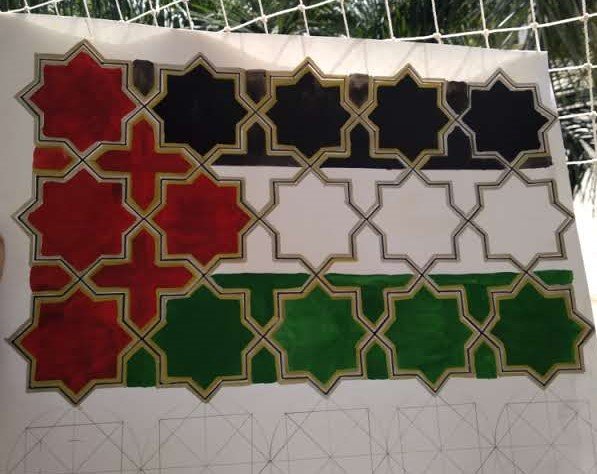
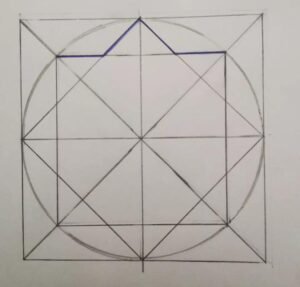
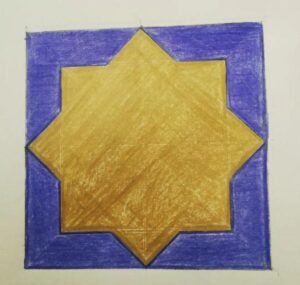
The circle symbolizes the fundamental concept of oneness and the origin of all forms. By dividing the circle into consistent segments, artists generate symmetrical patterns that can extend infinitely across a surface. The repetition of a single motif across a grid demonstrates how diversity is structured within coherence. The eight-pointed star (khatam), formed by two interlocking squares, symbolizes balance and harmony. The octagon mediates between the square, associated with the earthly realm, and the circle, associated with the heavenly realm. Such forms are not merely decorative; they invite contemplation. The visible pattern rests upon an invisible sub-grid, reminding the viewer that the apparent world rests upon unseen order.
Art: Sana Khan
The Breath of the Compassionate: Creation and Expansion
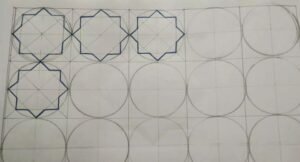
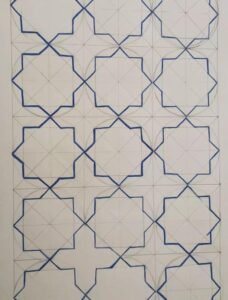
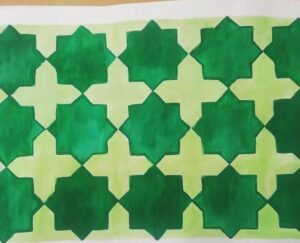
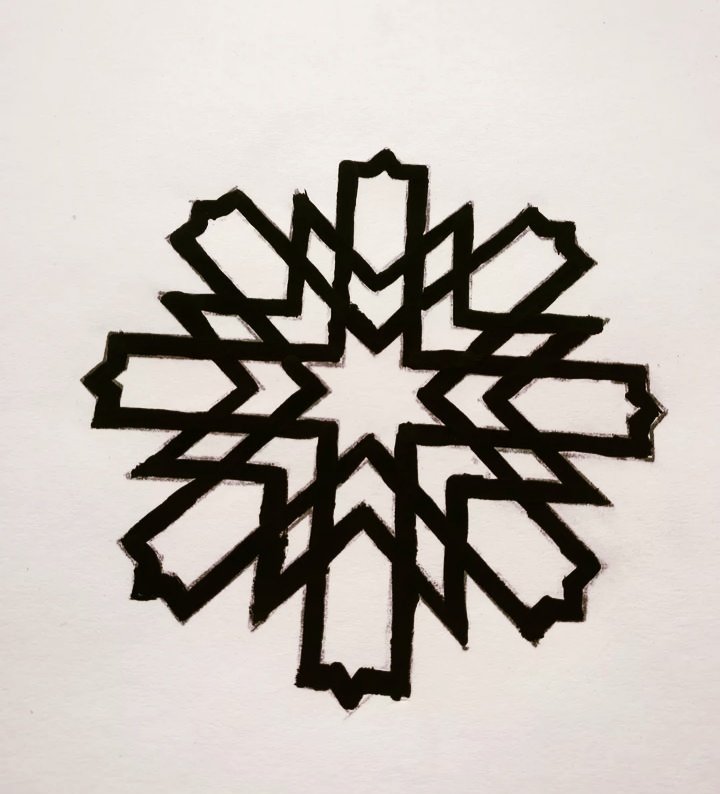
Relating Islamic geometric patterns with the Qur’an and Islamic teachings, the following design is called The Breath of the Compassionate5 – The pattern can be seen as tiling of smaller diagonal squares, half of which expand and the other half of which contract. It is for this reason it is termed as The Breath of The Compassionate, a name referring to the teachings of the great master Ibn-al- ‘Arabi which expound the Divine Breath as the basis of creation, liberating the possibilities of the four elements – fire, air, water, and earth (Sutton 2007).
Art: Sana Khan
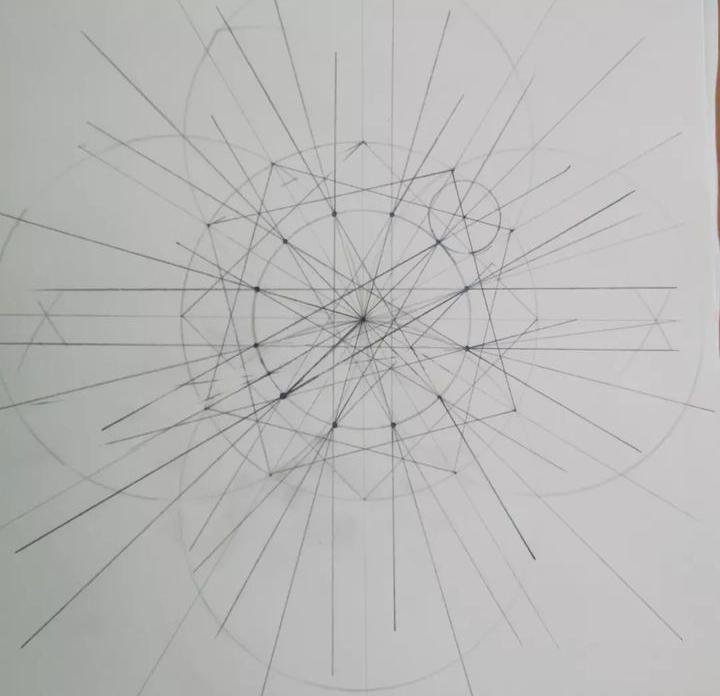
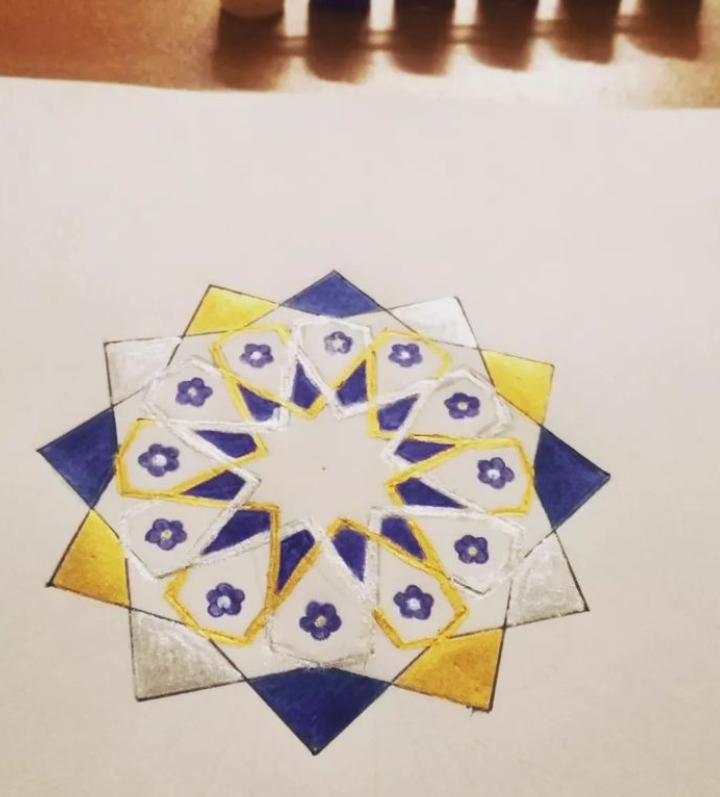
Islamic art possesses an intriguing characteristic. The embellishment of sacred structures with both floral and geometric motifs allow viewers to perceive the subtle harmonies that unite the natural world with the cosmos6. Take the above example – in Islamic architecture, the star or Khatam design consists of two identical squares positioned in an interposed manner, with one square rotated by 45 degrees. By deconstructing the Khatam, one can discover the fundamental elements of an eight-fold symmetry. By extending the parallel lines, a network of intersecting lines emerges, giving rise to various shapes and designs. The resulting cross pattern, often observed in mosques, is known as “The Breath of the Compassionate” design, as described above.
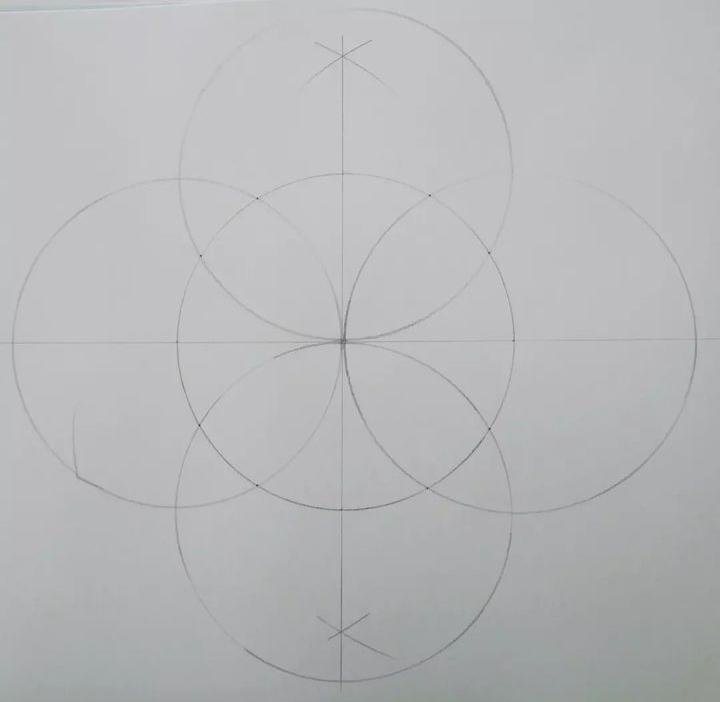
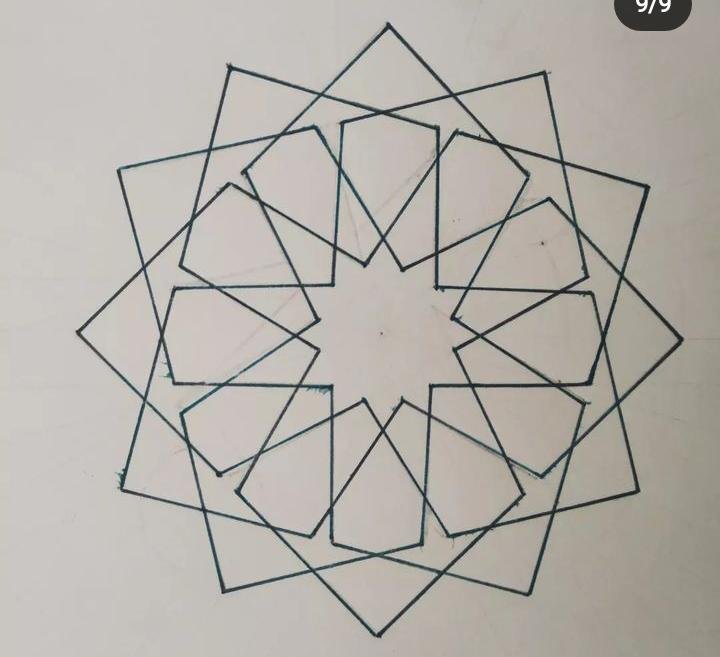
Within Islamic art, the circular geometric shape symbolizes the fundamental concept of oneness and the definitive origin of all forms of variation in existence. The essential division of the circle into consistent segments serves as the foundational element for numerous customary Islamic designs or patterns. In this instance, the process commences by dividing the circle into twelve equidistant sections, followed by the construction of parallel lines connecting the intersecting points.
Art: Sana Khan
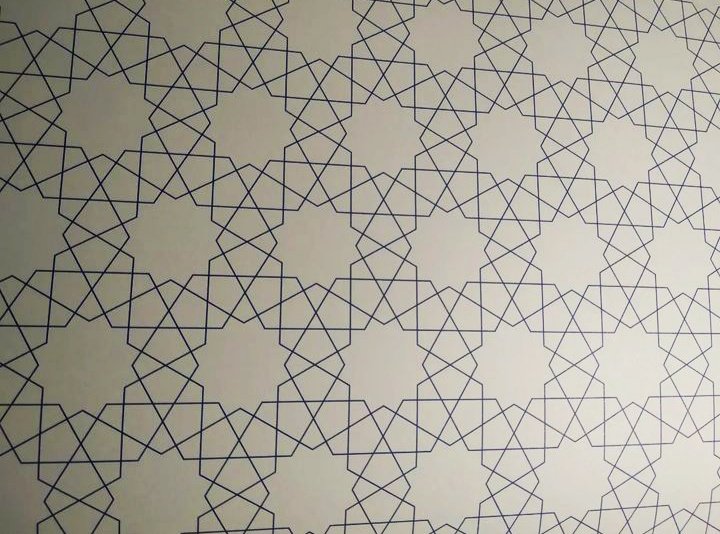
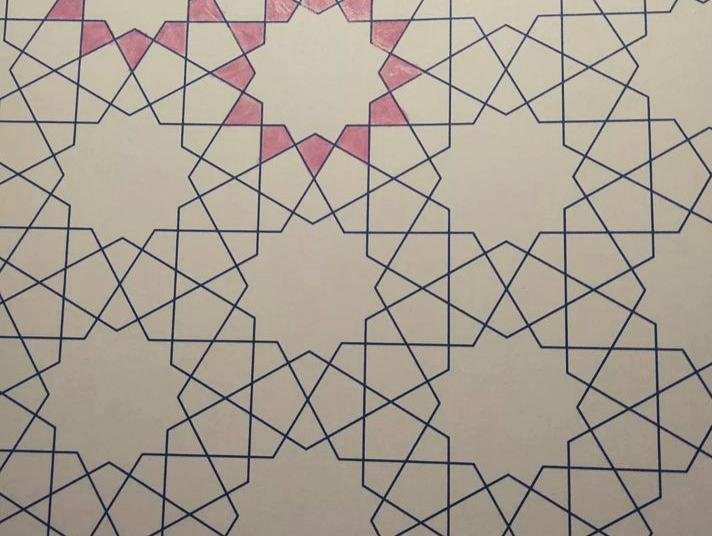
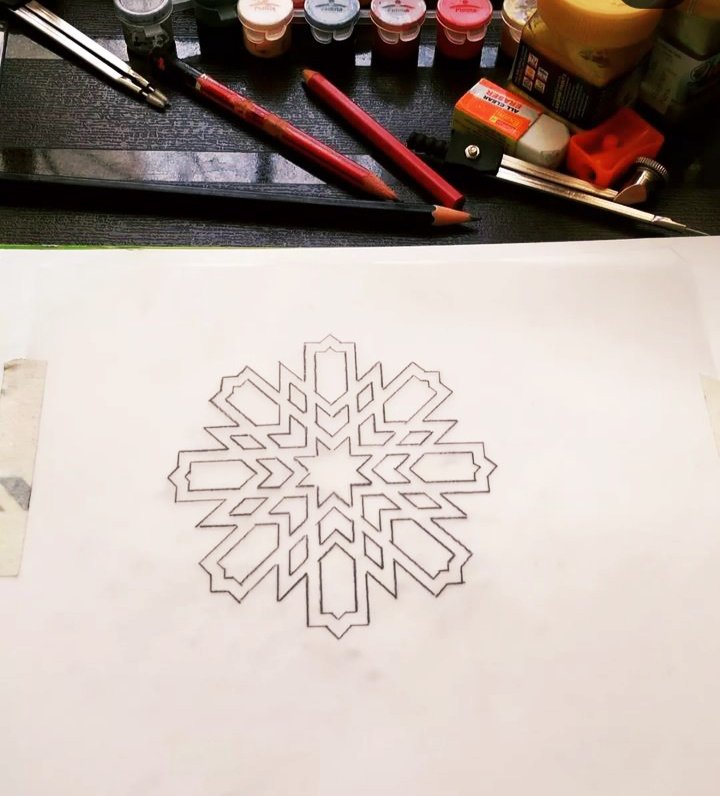
Geometric patterns in Islamic art (and architecture) are based on repetition of a single motif. It is designed in such a way that all the recurring components come together in a perfect sequence. So instead of designing a detailed pattern to cover an entire sheet of paper or wall, the artist can divide the surface into a grid of squares or hexagons, or circles, and then repeat the individual pattern or motif in each unit. The above pattern can be seen in the Shah Jahan Mosque, Thatta, Pakistan. Mosques usually have such intricate designs so as to remind the worshipper of the Creator.
Art: Sana Khan
Through the above grid one can say that the role of sacred art is to support the spiritual life of those whom it surrounds, it is to ingrain in them a way of perceiving the world and the subtle realities behind it (Sutton 2007). If one closely observes Islamic geometric patterns, and tries to understand their structures and meanings, one finds that this is an art form that seeks explicitly to explore the relationship between Unity and multiplicity, it is, at the same time unified yet diverse (Sutton 2007).
Art: Sana Khan
Colour, light and Qur’anic Imagery
There is significance attached to the colours used in Islamic art. Mehri (2016) points out that “colours are the factors for keeping the importance of the theme…the using of colors in a creative way is one of the characteristic features of Islamic art. It is known that the use of colours has a psychological effect on people… colours are very important for religion to convey its ideas, as the art”. In the Qur’an, in surah al-Baqarah, the word sibgha is used which means colour with the word Allah (God) – making it Sibghatullah in the Qur’an. Turkish scholar A. Yildrim writes, “this word (i.e., Sibghatullah) indicates that only God gives the real colour to beings” (Mehri 2016). Colours are used as metaphors for knowledge and wisdom, they could represent other meanings (as the nature of light appears through colours) such as the colours blue and white represent the purity of soul, red may symbolize fire and blood, yellow is a sign for good news or gladness, green is considered a Mubarak (blessed) colour, while the colour purple is seen to represent silence or death in Islamic art as is seen in the work of artists engaged in Islamic art.
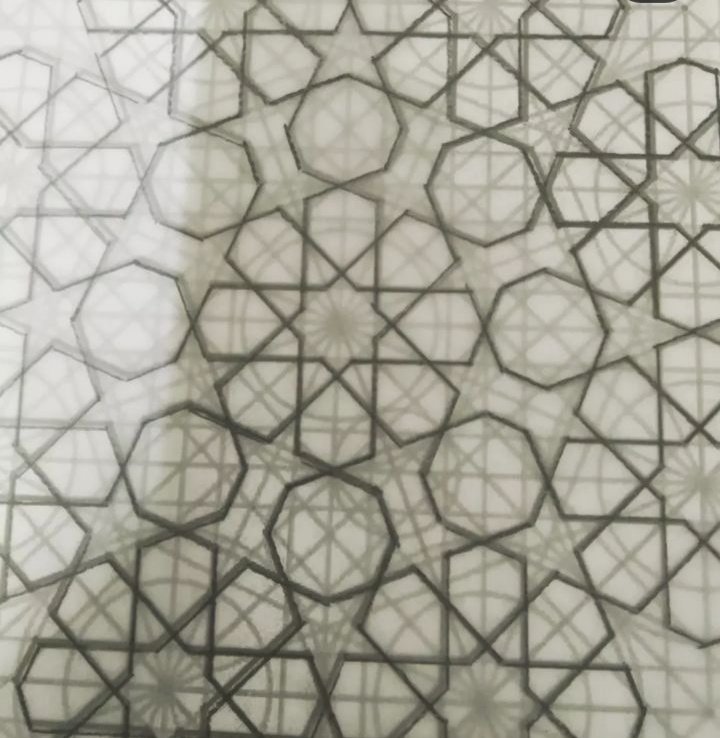
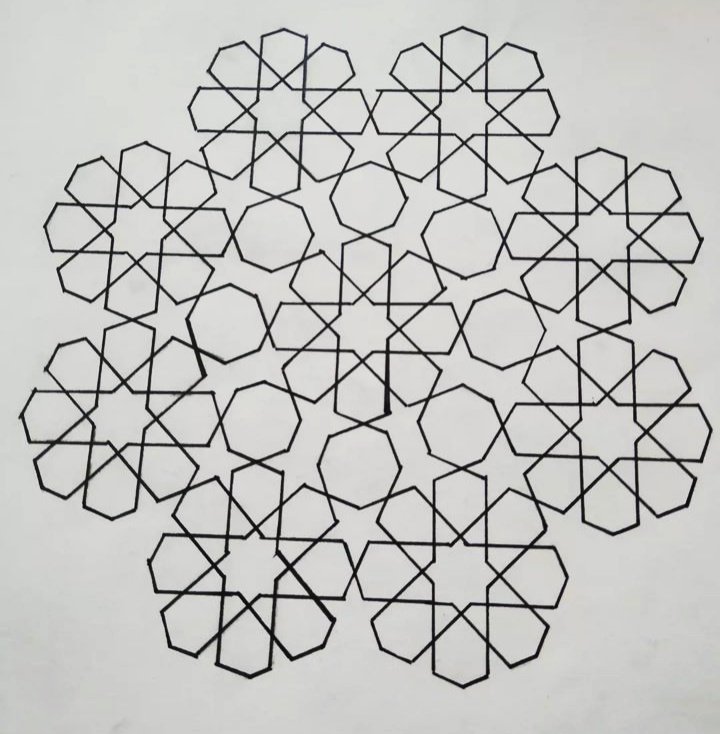
The following is an example of a rosette construction. This eight-fold rosette has many construction principles involved that makes one think of the divine. This particular pattern is a distinctive geometric rosette in Islamic art. Its petals are arranged around a central star like an archetypal crystalline flower (Sutton 2007). Rosette patterns such as this one can also be seen as a network of stellar motifs, inverting perception to picture the petals as negative space. One can repeat sections, could also be squares, or proportioned rectangles.
Art: Sana Khan
These beautiful patterns are often seen in mosques around the world. The idea of having such beautiful patterns is so that the space can be used to seek Sakinah – a deep peace inspired by the awareness or the consciousness of the presence of Allah (God). Many times, along with geometric patterns and arabesques (floral patterns), we witness verses of the Qur’an written in striking calligraphic form on the walls of the mosques.
Qur’an and Islamic Geometry
There are many ways in which the Qur’an can be related to Islamic geometry besides what we have seen above. For example, the Qur’an contains many verses that refer to the beauty of creation, and these verses have inspired artists to create geometric patterns that reflect the beauty of the natural world.
“Allah’s craftsmanship is evident as He arranges everything in perfect harmony” (Qur’an, al-Naml 27:88). Spahic Omer, an author on Islamic history, highlights that the Prophet Muhammad (PBUH) emphasized Allah’s beauty and love for beauty. According to Ibn al-Arabi, a renowned philosopher of Sufi speculative ontology, the divine beauty by which Allah is referred to as “Beautiful” and in which He takes pleasure, permeates all aspects of existence. Nothing exists except beauty, for God fashioned the cosmos in His own image, reflecting His infinite beauty. Thus, the entire cosmos, with all its elements and occurrences, is inherently beautiful. This profound meaning is also conveyed through art and architecture in the Islamic tradition. An exemplary instance is the Dome of the Rock in Jerusalem, Palestine. The architects intentionally constructed the building with an octagonal base and a circular dome, not only for structural strength but also to symbolize the Qur’anic belief that eight angels will carry the throne on the Day of Judgment7.
Some of the specific examples of how the Qur’an has been related to Islamic geometry could be: The Qur’anic verse “God is the Light of the heavens and the earth” (Surah an-Nur 24:35) has been interpreted as a reference to the infinite nature of God. This verse has inspired artists to create geometric patterns that represent the infinite nature of God (for e.g., patterns using Zellij)8.
The Qur’anic verse “He has made the seven heavens (and the earth in perfect order)” (Surah at-Talaq 65:12) has been interpreted as a reference to the order and symmetry of the universe. This verse has inspired artists to create geometric patterns that reflect the order and symmetry of the universe. Islamic scholars have stressed that God has created everything in proportion, this has been interpreted as a reference to the mathematical precision of the universe. These verses have inspired artists to create geometric patterns that are both beautiful and mathematically precise. The relationship between the Qur’an and Islamic geometry is a complex and fascinating one.
Geometry as Revelation: Concluding reflections
The use of geometry in Islamic art is not merely decorative; it is symbolic and contemplative. The Qur’an teaches that Allah created the universe in perfect order and harmony. Islamic geometric patterns visually articulate this order. Through circle and star, repetition and symmetry, visible pattern and invisible grid, geometry expresses tawhid—the unity underlying multiplicity.
To conclude, Islamic geometric art has a deep connection with the Qur’an and is believed to reflect the order and harmony of the universe, the unity and interconnectedness of all things. Islamic art forms reflect the richness and depth of Islamic culture and serve as a testament to the enduring influence of the Qur’an on Islamic art and thought.
Footnotes:
- For more details see: https://www.metmuseum.org/toah/hd/qura/hd_qura.htm#:~:text=The%20earliest%20Qur’ans%20were,tall%20shafts%20of%20the%20letters
- Hijra in Islam refers to the migration of Prophet Muhammad (PBUH) from Mecca to Medina in 622 CE to get away from persecution and to practice Islam freely. This also marks the beginning of Islamic calendar. For more details see https://www.britannica.com/event/Hijrah-Islam
- Arabesque or Islamil, are geometric patterns that are vegetal or floral in nature symbolising faith, “faith, light and illumination, the presence of nature, modesty, diversity in motifs and unity in content”- for more details see: https://architecture4design.com/arabesque-and-islimi-motifs-definitions-history-and-patterns/
- Oneness of God
- It symbolises the creation of the universe, divine mercy and compassion and the rhythmic expansion/contraction of life. The design is also seen as a bridge between the physical and spiritual realms.
- For more details see: https://alhamra-artworks.blogspot.com/2014?cv=1
- For more details see: https://medium.com/@neakhtar/islamic-geometry-art-history-6cab09be7747
- For more details see: https://zellijgallery.com/moroccan-tile/ & https://fatimazart.com/the-art-of-moroccan-zellij/
References
Grabar, Oleg (1973), “The Art of the Qur’an”, The Formation of Islamic Art, Yale University Press: New Haven.
Mehri, Gholamreza, “The Colour in Islamic Art”, Research J. Humanities and Social Sciences 2016; 7 (1): 25-28. Doi: 10.5958/2321-5828.2016.00006.1.
Rice, David Talbot (1965), Islamic Art, Thames and Hudson: London, UK.
Sutton, Daud (2007), Islamic Design: A Genius for Geometry, Wooden Books Ltd. Glastonbury, UK.
Internet sources
https://medium.com/@neakhtar/islamic-geometry-art-history-6cab09be7747
(The views expressed in this article are the author’s own. Content can be used with due credit to the author and to ‘Zariya: Women’s Alliance for Dignity and Equality’)
About the Author
Sana Khan teaches at the School of Education, Azim Premji University. Her areas of research include sociology of art and literature, sociology of education and political sociology. Beyond academia she is interested in learning and practicing Islamic art to understand that this art reflects spiritual and cultural significance.