In a Mimetic World: Mirroring of Textile References in the Jami Masjid
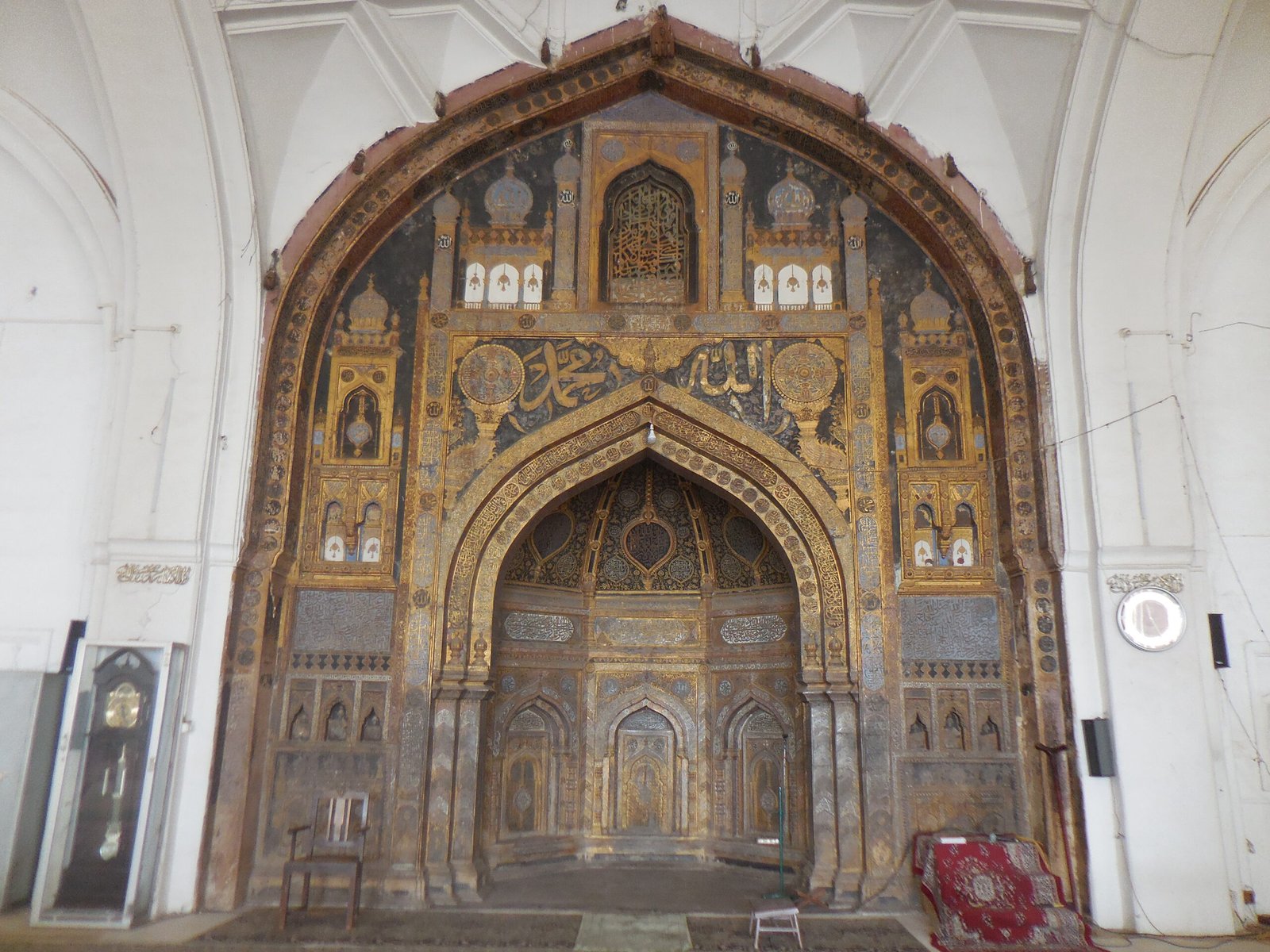
(Mihrab at the Jami Masjid, 17th century, Bijapur. Photo- Rajarshi Sengupta)
The visual vocabulary of Islamic monuments and artefacts contributes profusely to abstraction and mimetic experiences; however, mimesis in this context is primarily linked to isometric geometry and repetitive imagery.1 The transmedial references between poetry, music, art, architecture, and the human body further nuance the mimetic encounters and indicate a twofold, layered notion that considers copying or imitation, and a “palpable, sensuous connection between the very body of the perceiver and the perceived.”2 Doubling of spatial experiences created by the imbibing tactile presence of textiles and architecture foregrounds integration of spatial perception in the ornate prayer space of the Jami Mosque in Bijapur, Karnataka.
Close cultural, marital, and trade relations persisted between the Deccan sultanates, such as the Adil Shahi sultanate of Bijapur, and the Turko-Iranian Empires. The model of Turko-Persian kingship and art also served as a tool to resist the cultural dominance of the powerful Mughal Empire and to mark a distinctive identity for the Deccanis. Subsequently, since the reign of Ibrahim Adil Shah (1535-58), greater integration of Deccani architectural and cultural forms was celebrated.3 While the Timurid and Safavid architectural elements constituted the core of the Bijapuri structures, Indic and Turkic influences, among others, are prominently featured.4 Bulbous domes, rings of petals decorating the base of the domes and tall, slender minarets are identified as key characteristics of the Adil Shahi structures.5
The mosque was first erected by Ali I (1558-79), an Adil Shahi king of Turkish and Persian origin, during 1576, but was never completed.6 The Mihrab, the arched niche in the prayer hall, holds an inscription with the name of Allah, which was completed in 1636.7 The mihrab faces the Kaaba in Mecca as indicated by the qibla. Made in low relief and richly painted with colors and gold, this mihrab is “one the grandly proportioned and sumptuously decorated in the Islamic world.”8 The mihrab draws heavily on both the structure and ornamentation of the Adil Shahi buildings. The central archway is topped by a smaller archway, two domed pavilions on the sides and minarets thus replicating the symmetry of the built prayer hall. The interior of the domed pavilions is brightly painted in white and features hanging lamps. The tiered pavilions between the central archway and frame of the mihrab are represented as especially elongated, possibly to fit them within the narrow compositional space. With the interplay of slightly recessed and projected sections in the mihrab an illusion of a physical architecture is created. The meticulous depiction of architecture to create an outdoor space within the interior of the mosque creates a mirroring experience of spaces in the mihrab. In and around the mihrab, miniature domed structures bear a striking resemblance to another celebrated Adil Shahi monument, Ibrahim Rouza—the tomb complex of Ibrahim Adil Shah II. This unusual reference to an existing structure in the mihrab contributes to its distinctiveness.
The organisation of the magnificent archway, minarets, hanging lights, and tiered building structures are resonated in the famed mordant and dye painted kalamkari textiles of Golconda (Image https://www.metmuseum.org/art/collection/search/447118 ); only, the crowd in the textile is replaced with the serenity of the mihrab. Since both the hanging and the mihrab were made during the first half of the seventeenth century, it is possible that the dyed textile makers and the architects were aware of each others’ practices; if not via direct correspondence, they were connected by intermediaries such as reference drawings and templates. The intermedial reference to textiles in the mihrab is further established by the eye loop hooks around the arch to hold a curtain. Residents around the mosque recalled a white curtain covering the ornate mihrab before the Archaeological Survey of India took over the mosque. The collective recalling of the curtain layering over the early modern mihrab, replete with rich textile references, evokes an intertwining of presence and absence.
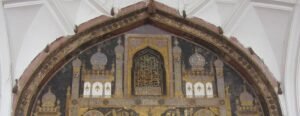
Mihrab with visible hooks around the arch. Photo- Rajarshi Sengupta
Above the minbar or raised pulpit, a set of three miniature archways portrays a rather peculiar architectural style—arches that take the shape of drawn curtains, in the picture below.
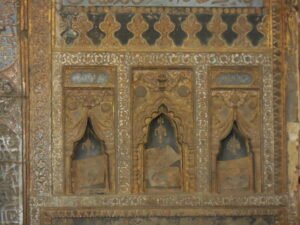
Mihrab at the Jami Masjid, 17th century, Bijapur. Photograph: Rajarshi Sengupta.
This set of archways is mirrored on the left of the mihrab as well. Within these archways, meticulously bound books are painted, reflecting the taq or niches in the mosque, which are still used to store books and rosaries. The curtains are drawn in a way that the repositories of knowledge are revealed to the viewers. At the far ends of the rectangular prayer hall, a large archway is flanked by a pair of drawn-curtain miniature niches, resonating the compositional arrangement of the central mihrab.
On one hand, the mimetic encounters between architecture and textiles refer to the vibrant trade and cultural exchanges around textiles in the Deccan and Coromandel Coast during the early modern era; on the other hand, the concepts of revealing and concealing facilitated by the textile references in this built structure compel the beholders to envision the mirroring of abstract ideas into material forms.
Footnotes:
1. Wendy M. K. Shaw, “Mimetic Geometries,” in What is “Islamic” Art?: Between Religion and Perception (Cambridge: Cambridge University Press, 2019), 291-2.
2. Taussig, “Physiognomic Aspects,” 21.
3. Richard M. Eaton and Phillip B. Wagoner, “Bijapur’s Revival of the Chalukya Imperium,” in Power, Memory, Architecture: Contested Sites on India’s Deccan Plateau, 1300-1600 (New Delhi: Oxford University Press, 2013), 128-9.
4. Sara Mondini, “The Jami Masjid Miḥrāb of Bijapur: Inscribing Turkic Identities in a Contested Space,” in Turkish History and Culture in India : Identity, Art and Transregional Connections, eds. A.C.S. Peacock Richard Piran McClary (Leiden and Boston, 2020), 274.
5. Ibid., 285.
6. George Michell and Mark Zebrowski, “Mosques and Tombs,” in Architecture and Art of the Deccan Sultanates (New York: Cambridge University Press, 1999): 88.
7. The Oxford Dictionary of Architecture (3 ed.), s.v. “Mihrab,” by James Stevens Curl and Susan Wilson, accessed January 10, 2019, http://www.oxfordreference.com.ezproxy.library.ubc.ca/view/10.1093/acref/9780199674985.001.0001/acref-9780199674985-e-5783
8. Michell and Zebrowski, “Mosques,” 88.
(The views expressed in this article are the author’s own. Content can be used with due credit to the author and to ‘Zariya: Women’s Alliance for Dignity and Equality’)
ABOUT THE AUTHOR:
Rajarshi Sengupta is a practitioner and art historian, presently teaching fine arts at the Dept. of Humanities and Social Sciences, Indian Institute of Technology (IIT) Kanpur, India (2021-). He holds a PhD in art history from the University of British Columbia, Vancouver (2019). Sengupta co-edited Another Hyderabad in Deccan: Material Culture and Artistic Practice in Deccan (Bloomsbury 2025) with Prof. Baishali Ghosh. His dyed textiles were displayed in his recent solo exhibition, Poetics of Juxtaposition & Soft Rustle of Time, Apparao Galleries, New Delhi (2025).